Will my 40-second health check show if I'm too stressed to operate heavy machinery?
How occupational health screening technology reads stress markers in a 40-second pre-shift scan, and what that means for safety-critical workers and EHS teams.
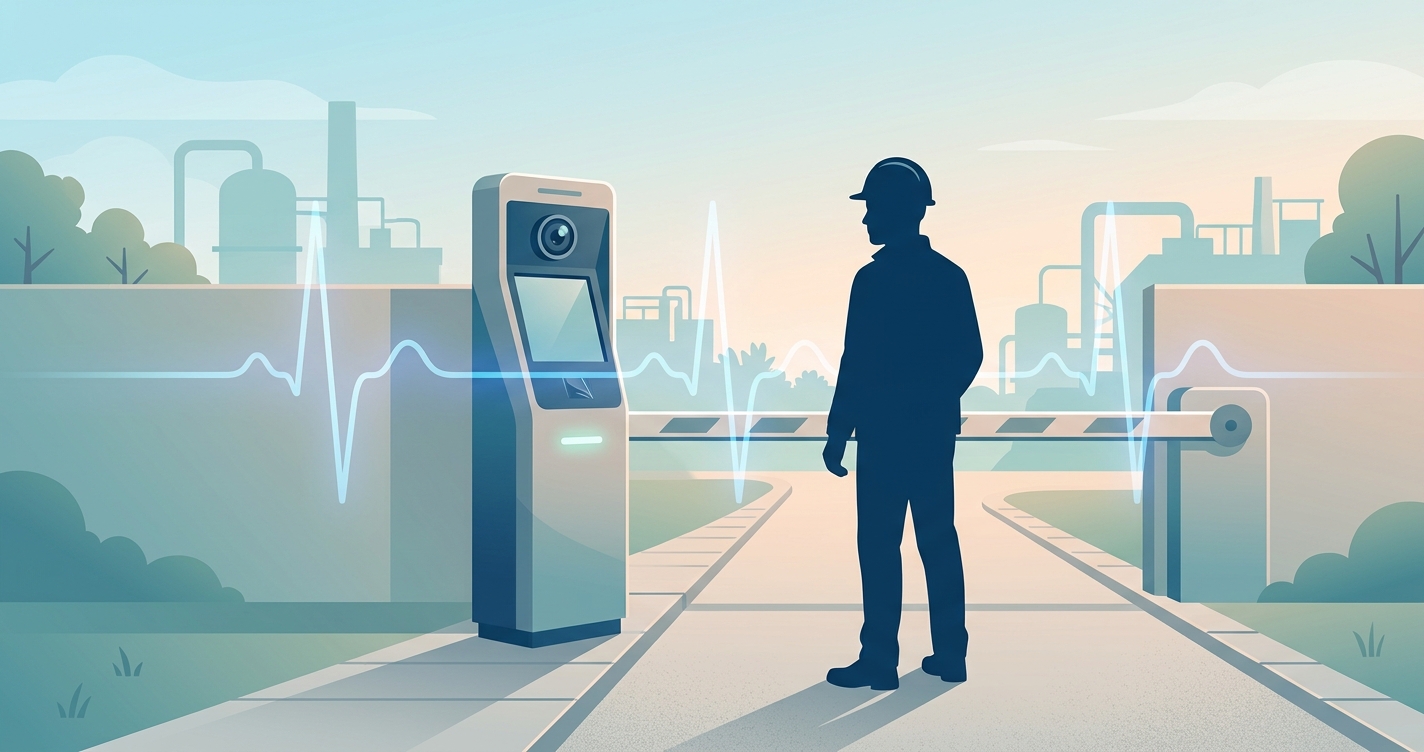
If you operate a forklift, a crane, a haul truck, or a press, you already know the quiet calculation that happens before a shift: am I sharp enough to do this safely today? Stress is one of the hardest variables to judge from the inside, and it rarely announces itself the way a fever or an injury does. This is exactly the gap that occupational health screening technology is built to address. A 40-second pre-shift scan does not read your mind or diagnose anxiety, but it can pick up the physiological signature that elevated stress leaves on your body, the same signals that influence reaction time and judgment behind the controls of heavy equipment.
Approximately 77 percent of workers reported experiencing work-related stress in the prior month, and healthcare expenditures run nearly 50 percent higher for employees who report high stress levels, according to the American Psychological Association 2023 Work in America Survey and NIOSH summaries.
What occupational health screening technology actually measures
Stress is not a single number. When the body shifts into a heightened sympathetic state, several measurable things change at once: heart rate tends to rise, heart rate variability (HRV) drops, breathing rate increases, and blood pressure can climb. Occupational health screening technology built on remote photoplethysmography (rPPG) reads these markers from a short video of your face. The camera detects tiny color changes in the skin caused by blood flow with each heartbeat, then extracts pulse, breathing, and HRV from that signal.
HRV is the marker most closely tied to stress. It reflects the balance between the sympathetic ("fight or flight") and parasympathetic ("rest and recover") branches of your autonomic nervous system. When you are calm and recovered, the spacing between heartbeats varies naturally. Under acute stress or heavy fatigue, that variability narrows. Research groups working with the UBFC-Phys dataset in 2023 and 2024 reported hybrid deep-learning models reaching up to 95.83 percent accuracy for stress classification from facial video, and contactless HRV studies have published mean absolute errors near 6 to 10 milliseconds for standard HRV metrics under controlled conditions.
The important honest point: a 40-second scan flags a physiological state, not a cause. It cannot tell whether your HRV is low because of a fight at home, a poor night of sleep, caffeine, or genuine job strain. What it can do is signal that your body is not in a baseline-ready state, which is the information a fitness-for-duty program is designed to act on.
How a stress-aware scan compares to other readiness checks
Different pre-shift methods answer different questions. A breathalyzer answers "is this person impaired by alcohol?" It says nothing about stress or fatigue. Self-report checklists capture how a worker feels but are easy to game when someone wants the shift. A contactless vitals scan sits in a different category: objective, fast, and able to surface stress and fatigue signals that the worker may not even recognize.
| Screening method | Detects stress / HRV | Time per worker | Worker friction | What it misses |
|---|---|---|---|---|
| Contactless vitals scan (rPPG) | Yes, via HRV, pulse, breathing | 30 to 60 seconds | Low, no contact | Root cause of the stress |
| Breathalyzer | No | 30 to 60 seconds | Moderate, contact device | Stress, fatigue, illness |
| Self-report checklist | Indirect, self-perceived only | 1 to 3 minutes | Low | Honest disclosure, hidden states |
| Wearable HRV tracker | Yes, continuous | Passive | Device must be worn and charged | Consistency, hygiene, compliance |
| Clinical exam | Yes, thorough | 15 to 45 minutes | High | Practicality for daily shifts |
The trade-offs are clear:
- A contactless scan is the only method on this list that is both fast enough for daily gate use and capable of surfacing stress-related physiology.
- It is a screen, not a diagnosis. A flagged result should trigger a conversation or a follow-up, not an automatic penalty.
- Combining an objective scan with a brief self-report tends to outperform either method alone, because physiology and lived experience fill each other's blind spots.
Why stress matters for heavy machinery operation
Acute stress measurably degrades the cognitive functions that safe equipment operation depends on. A review of acute stress and human performance (PMC, 2018) found that stress narrows attention, slows decision-making, and increases the rate of human error, the precise failures that turn a routine lift or maneuver into an incident. A systematic review and meta-analysis of workplace stress and occupational injuries (Int. J. Environ. Res. Public Health, 2022) reported a consistent association between high job strain and elevated injury rates.
The cost picture for safety teams
NIOSH and the UMass Lowell Center for the Promotion of Health in the New England Workplace estimate job stress costs American employers more than 300 billion dollars annually through absenteeism, turnover, reduced performance, and medical costs. A 2022 NIOSH study found workers in highly precarious jobs were 57 percent more likely to report job stress. For an EHS director, those numbers translate directly into incident risk on equipment where a single lapse can be catastrophic.
Where pre-shift stress screening fits
The goal is not to send stressed workers home. It is to give supervisors an objective prompt to redeploy, reassign, or check in before someone climbs into a cab. A flagged scan might mean a short rest, a task swap to lower-risk work, or simply a brief human conversation that catches a problem the worker was too proud or too rushed to raise.
Current research and evidence
The evidence base for contactless physiological screening has matured quickly. Work on robust HRV measurement from facial video, published through PubMed and PMC, demonstrates that camera-based methods can track autonomic markers with usable accuracy when motion and lighting are controlled. Reviews of rPPG for health assessment note that the technology now extracts pulse, breathing rate, HRV, and estimated blood pressure from standard cameras, though they are candid about the remaining challenges.
Those limitations matter for any safety program:
- Motion artifacts from a worker fidgeting or talking can corrupt the signal, which is why scans require a brief still moment.
- Lighting variation at a plant gate or job-site trailer affects signal quality.
- Personalized baselines outperform population averages, because a "normal" HRV for one worker may be a warning sign for another.
The practical takeaway from the literature is consistent: contactless stress and fatigue screening is strong as a trend-and-flag tool measured against each worker's own baseline, and weaker when treated as a one-time absolute diagnosis. That distinction should shape how any program sets thresholds and responds to results.
The future of occupational health screening technology
The near-term direction is multimodal and longitudinal. Research teams are already combining rPPG vitals with facial-expression and voice analysis to sharpen stress assessment, and the same logic applies on a worksite, where a scan can be cross-checked against schedule data, heat conditions, and prior readings. Over time, a stress-aware scan becomes most valuable not as a single gate reading but as a daily data point that reveals when a worker, a crew, or an entire shift pattern is drifting toward elevated risk.
Expect tighter integration with safety management systems, clearer privacy frameworks governing what stress data employers may collect and retain, and better personalized baselines that reduce false flags. For workers, the trajectory points toward screening that feels less like surveillance and more like the equipment inspection done before every shift: a quick, routine check that protects the person doing the job.
Frequently asked questions
Will a 40-second scan diagnose me with anxiety or a mental health condition? No. The scan measures physiological markers such as heart rate variability, pulse, and breathing rate that change under stress. It flags a state of elevated stress or reduced readiness, but it does not diagnose a clinical condition or identify the cause. Any flag is a prompt for follow-up, not a medical verdict.
Can it actually tell stress apart from fatigue or a hangover? Not perfectly. Stress, fatigue, dehydration, and alcohol can all push heart rate variability and pulse in similar directions. That overlap is why a good program compares your reading to your own baseline and pairs the scan with a brief check-in rather than treating one number as the whole story.
Could a stressed scan result get me sent home or penalized? A well-designed fitness-for-duty program uses results to redeploy, reassign, or start a conversation, not to punish. The intent is protective: catching a high-risk state before someone operates dangerous equipment. Reasonable programs build in repeat scans and human review before any decision affects pay or status.
How accurate is contactless stress screening? In controlled studies, camera-based HRV and stress models have reported strong accuracy, including classification rates above 95 percent on research datasets. Real-world conditions like motion and lighting lower that performance, so the technology is best used as a trend-and-flag tool against a personal baseline rather than a single absolute measurement.
For EHS directors weighing how to fold stress and fatigue signals into a fitness-for-duty program, Circadify is developing contactless pre-shift screening aimed at exactly this problem on safety-critical worksites. To discuss building a stress-aware screening program for your crews, start a safety program inquiry at circadify.com/solutions/fraud-detection.