5 Industries Adopting Contactless Health Checks Fast
A sector-by-sector look at industrial health screening contactless adoption, the safety gains EHS teams report, and where pre-shift vitals are heading next.
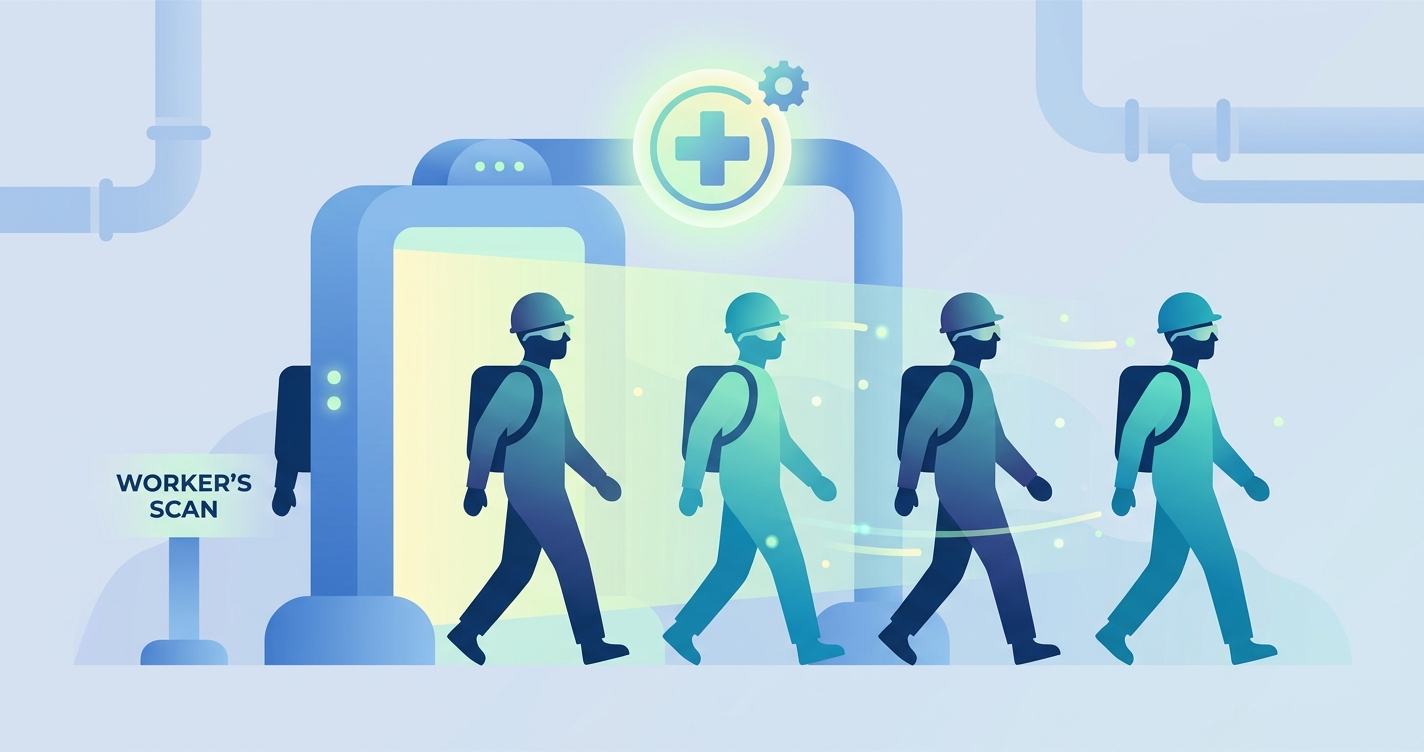
Pre-shift readiness used to be a clipboard question. A supervisor eyeballed the crew, asked how everyone slept, and signed off. That informal screen is being replaced across safety-critical sectors by industrial health screening contactless tools that read heart rate, breathing rate, and signs of strain from a short camera-based scan at the gate. The shift is not driven by novelty. It is driven by a measurable cost problem that EHS directors have been tracking for years, and by camera-based physiology finally becoming fast and hygienic enough to run on every worker, every shift, without slowing the line.
The National Safety Council estimates that worker fatigue costs employers between $1,200 and $3,100 per employee each year in lost productivity, and attributes roughly 13% of all workplace injuries to fatigue. Its surveys also report that more than 90% of employers say tired workers affect their operations.
Why industrial health screening contactless tools are spreading now
Two forces are converging. The first is regulatory and financial pressure on fatigue and fitness-for-duty programs. The second is the maturation of remote photoplethysmography (rPPG), the camera-based technique that detects subtle color changes in facial skin caused by blood flow. A 2024 systematic review published in MDPI sensors literature, along with validation work summarized in PMC, reports heart rate accuracy from smartphone and tablet rPPG reaching the mid-90s percent range against reference devices, with oxygen saturation around 93%. Blood pressure remains more variable and is treated as a screening signal rather than a diagnostic reading.
For an EHS director, the appeal of contactless health checks by industry is operational. A contactless station does not require disposable cuffs, does not create a touchpoint that crews share, and does not demand a clinician at the gate. It produces a readiness signal in under a minute. The table below summarizes how the five fastest-adopting sectors are deploying these tools and what they are trying to prevent.
| Industry | Primary risk addressed | Typical screening point | Reported priority gain |
|---|---|---|---|
| Mining | Fatigue, heat strain, altitude effects | Pre-shift muster, lamp room | Fewer haul-road and equipment incidents |
| Oil and gas | Fatigue, cardiovascular events in remote sites | Site gate, control room entry | Faster medevac decisions, fewer lone-worker emergencies |
| Transportation and logistics | Driver and operator fatigue | Yard check-in, dispatch | Hours-of-service support, fewer microsleep events |
| Construction | Heat stress, exertion, fitness for duty | Site entry turnstile | Reduced struck-by and fall exposure |
| Manufacturing and warehousing | Repetitive strain, shift-lag fatigue | Clock-in kiosk, line entry | Lower presenteeism, fewer line-stoppage incidents |
Across all five, the common thread is the same: catch a degraded physiological state before a worker touches a machine, not after an incident report is filed.
The five sectors moving fastest
1. Mining
Mining combines long shifts, remote camps, night rotations, and heavy mobile equipment. Fatigue on a haul road is a well-documented hazard, and many operations already run fatigue management systems. Contactless screening use cases here center on the pre-shift muster, where crews already gather. A scan at the lamp room adds a physiological data point to the existing sign-on, flagging workers whose readings suggest poor recovery or early heat strain before they board a haul truck. The remote nature of mine sites also raises the stakes on any medical event, which pushes operators toward early-warning screening.
2. Oil and Gas
Offshore platforms and remote land rigs face a hard constraint: medical help is hours away. That distance changes the math on prevention. Industries using fitness for duty scans in upstream energy tend to place stations at site gates and control-room entries, screening for fatigue and cardiovascular warning signs in a workforce that skews older and works extended rotations. The same hygiene logic that accelerated contactless adoption during respiratory illness seasons also applies to shared, harsh-environment facilities where touch-based devices degrade quickly.
3. Transportation and Logistics
Driver fatigue is the textbook case for workplace contactless vitals. Rail, trucking, and large distribution yards operate around the clock, and fatigue regulation in transport is among the most developed in any sector. Contactless checks at yard check-in or dispatch give safety teams a physiological reading to complement hours-of-service logs, which only capture time on duty and not actual recovery. A driver can be legal on paper and still be operating after a poor night of sleep. A camera-based scan adds the missing signal without a blood draw or a breath test.
4. Construction
Construction sites are temporary, crowded, and increasingly exposed to extreme heat. Site-entry turnstiles are a natural screening point, and contactless health checks by industry data show construction moving quickly because the entry gate already exists as a controlled chokepoint. Heat stress monitoring is a particular driver, as is general fitness for duty on sites where a single impaired worker at height or near mobile plant creates risk for the whole crew.
5. Manufacturing and Warehousing
High-throughput plants and fulfillment centers run rotating shifts that disrupt circadian rhythm. Here the gains are framed less around catastrophic events and more around presenteeism, the productivity loss when a worker is present but functionally impaired. A clock-in kiosk that adds a contactless readiness scan lets supervisors redirect a degraded worker to a lower-risk task rather than a press or a powered conveyor. Given that NSC surveys report 97% of workers face at least one fatigue risk factor, the scale of this population makes even small per-worker gains significant.
Current research and evidence
The evidence base sits in two layers. On fatigue cost and prevalence, the National Safety Council provides the most cited figures: the $1,200 to $3,100 per-employee annual cost, the 13% injury attribution, and the finding that workers sleeping under six hours per night cost employers roughly six lost workdays a year. These numbers anchor the business case that EHS directors bring to procurement.
On the measurement technology, validation has advanced steadily. The 2024 MDPI review of non-contact vision-based vital sign monitoring and the PMC analysis of non-contact photoplethysmography mobile applications both report strong heart rate agreement and usable oxygen saturation estimates, while noting that motion, lighting, and skin tone affect accuracy. A separate finding reported via News-Medical in 2024 cautions that rPPG accuracy can drop at elevated heart rates, which is why responsible deployments treat the scan as a triage and routing signal, not a clinical diagnosis. For pre-shift screening, that distinction matters: the goal is to flag who needs a closer human check, not to replace medical evaluation.
The future of industrial health screening contactless programs
Three developments are likely to define the next phase. First, integration. Standalone kiosks generate a number, but value compounds when readings flow into a safety management system alongside hours-of-service, incident history, and task assignment. Second, trend analysis. A single scan is a snapshot, but a per-worker baseline lets teams detect drift over a rotation, which is more useful than any one reading. Third, sector-specific tuning. The mining muster, the rig gate, and the warehouse kiosk have different lighting, throughput, and risk profiles, and screening protocols will diverge accordingly rather than converging on one template.
The direction of travel is clear. As deep learning improves rPPG robustness in motion and variable light, contactless screening use cases will extend from controlled gates to more dynamic environments. The constraint will be governance, not capability: consent, data handling, and the line between a readiness signal and a medical record will shape how fast each sector moves.
Frequently asked questions
What does a contactless health check actually measure before a shift?
Most camera-based systems estimate heart rate, breathing rate, and related signals from a short facial scan, sometimes adding oxygen saturation and a screening-level blood pressure indicator. These feed a readiness or fitness-for-duty signal rather than a clinical diagnosis.
Which industries are adopting contactless screening the fastest?
Mining, oil and gas, transportation and logistics, construction, and manufacturing or warehousing are moving quickest. Each has long shifts, safety-critical tasks, and an existing entry chokepoint where a quick scan fits naturally.
Is contactless screening accurate enough for safety decisions?
Research reports strong heart rate accuracy and usable oxygen saturation estimates, with more variability for blood pressure and at elevated heart rates. Because of this, mature programs use scans to triage and route workers for a closer check, not to make standalone medical calls.
How is contactless screening different from a breathalyzer or wearable?
A breathalyzer detects alcohol only, and wearables require devices on every worker plus charging and compliance. A contactless scan captures multiple physiological signals at a shared station in under a minute with no device per worker and no shared touchpoint.
Circadify is building toward this exact need: fast, hygienic, sector-aware pre-shift screening that gives safety teams a readiness signal without slowing the line. EHS directors evaluating contactless programs for their specific sector can request an industry-specific walkthrough at circadify.com/solutions/fraud-detection.