How can I quickly check my vitals without touching anything before my shift starts?
A research look at industrial health screening contactless methods that let safety-critical workers check vitals fast and hygienically before a shift.
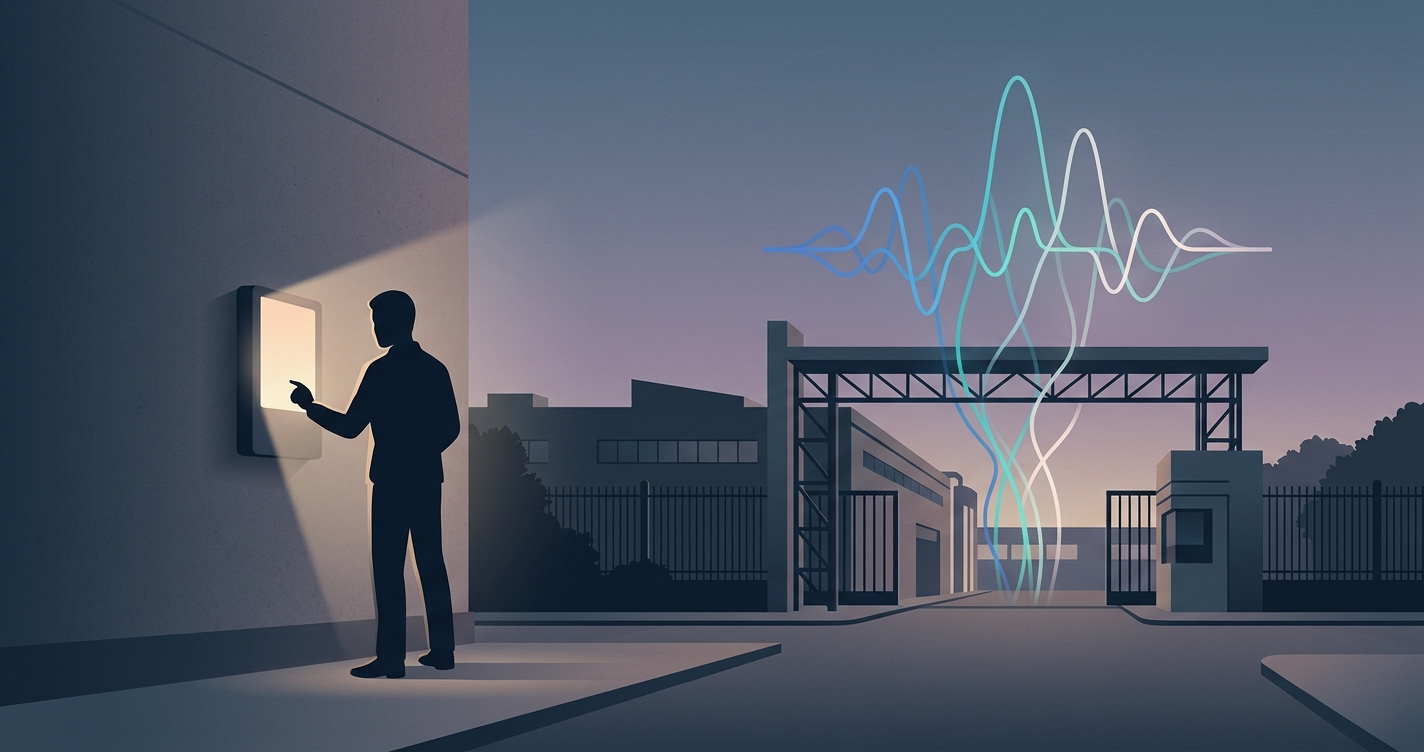
Before a worker steps onto a plant floor, a rig deck, or a haul road, the body already holds most of the information a safety team needs. Heart rate, breathing rate, and subtle signs of strain or exhaustion are present at the gate, minutes before the first task. The operational challenge has always been reading those signals quickly, hygienically, and without slowing down a shift start that may involve hundreds of people crowding into a muster point. This is the gap that industrial health screening contactless technology is built to close: a way to read vitals through a camera or kiosk, no cuff, no mouthpiece, no shared surface, in under a minute.
A 2024 systematic review of non-contact vision-based vital sign monitoring published in the journal Sensors (MDPI) reported that camera-based remote photoplethysmography can estimate resting heart rate with a mean absolute error below 3 beats per minute under controlled conditions, with some implementations approaching 99 percent agreement against reference devices.
What industrial health screening contactless technology actually measures
The core method behind most touch-free systems is remote photoplethysmography, usually shortened to rPPG. A standard color camera detects tiny changes in the light reflected from the skin of the face. Those changes track the volume of blood moving through capillaries with each heartbeat. From that signal, software can derive heart rate, heart rate variability, respiratory rate, and in some research settings, estimates of blood oxygen saturation and blood pressure trends. Because the only thing touching the worker is light, the process is inherently hygienic and fast.
For a safety manager, the appeal is practical rather than clinical. A worker stands in front of a kiosk or tablet, looks at the screen for roughly 30 to 60 seconds, and a reading is produced. No one shares a cuff. No one wipes down a mouthpiece. No nurse is required at the gate for routine checks. The line keeps moving.
It helps to compare the touch-free approach against the screening methods most worksites already use.
| Screening method | Contact required | Typical time per worker | Hygiene profile | Throughput at shift start |
|---|---|---|---|---|
| Contactless camera (rPPG) | None | 30-60 seconds | High, no shared surface | High, self-service kiosk |
| Blood pressure cuff | Direct, shared cuff | 1-2 minutes | Low, surface cleaning needed | Low, staff-operated |
| Breathalyzer | Mouthpiece contact | 1-3 minutes | Low, disposables required | Low to moderate |
| Wearable sensor | Worn on body | Continuous after fitting | Moderate, personal device | Moderate, setup time |
| Manual nurse check | Direct | 3-5 minutes | Moderate | Very low |
The pattern is clear. Contact-based methods are accurate and familiar, but they create bottlenecks and hygiene overhead exactly at the moment a shift change concentrates the most people in one place.
Why speed and hygiene moved up the priority list
Several pressures pushed touch-free screening from novelty to serious consideration:
- Respiratory illness awareness raised expectations for low-contact entry procedures across industrial sites.
- Labor throughput matters; a two-minute check across 300 workers is ten hours of cumulative delay per shift change.
- Worker acceptance is higher for a quick glance at a screen than for a cuff or a mouthpiece.
- Data capture is automatic, which removes the transcription errors common in manual logs.
Industry applications for touch-free pre-shift checks
Heavy equipment and transportation
Operators of forklifts, cranes, haul trucks, and locomotives carry outsized risk because a lapse becomes a multi-ton problem in seconds. A fast vitals reading at the gate gives a baseline that can be compared shift over shift, flagging the worker whose resting heart rate or breathing pattern has drifted well outside their personal norm.
Energy, mining, and remote sites
Crews working at altitude, in heat, or far from medical support benefit from a documented pre-shift snapshot. A contactless kiosk can sit at a muster point with no dedicated medical staff, capturing readings even where a clinic is hours away.
Manufacturing and logistics
High-volume facilities run shift changes that funnel large crews through a single entry in a compressed window. Self-service contactless stations preserve throughput while still producing a consistent record for every worker, every shift.
Current research and evidence
The evidence base for camera-based vitals has grown quickly. The 2024 Sensors review noted above documented strong agreement for resting heart rate while flagging the conditions that degrade performance. A separate analysis covered by News-Medical in 2024 found that rPPG accuracy can drop sharply at elevated heart rates, which matters for any application involving exertion rather than a calm pre-shift moment. Researchers publishing in Frontiers in 2024 described how deep learning models are narrowing the gap by suppressing motion artifacts and adjusting for variable lighting and a wider range of skin tones, three of the historic weaknesses of the method.
Fatigue detection is advancing along a parallel track. A peer-reviewed study on a contactless fatigue level diagnosis system, indexed in PubMed Central, combined video, thermal, and audio inputs and reported fatigue classification accuracy approaching 89 percent. The direction of travel is multimodal: a single signal is suggestive, but several signals read together produce a more reliable readiness picture.
Institutional interest is also building. The National Safety Council announced funding in 2026 for pilot programs testing fatigue-detection technologies, including smartphone and camera analytics, in real work environments. That kind of backing signals a shift from laboratory promise toward field validation.
A measured reading of the literature points to three honest conclusions:
- Resting vitals via camera are reliable enough to support trend-based screening, not diagnosis.
- Motion, lighting, and physical exertion remain the main accuracy limiters.
- Multimodal systems outperform any single-signal approach for fatigue.
The future of contactless pre-shift screening
The next phase is less about whether a camera can read a heartbeat and more about how the reading fits into a safety program. Three developments are likely to define it.
First, integration. Pre-shift readings will flow directly into safety management systems, building a per-worker baseline that makes an unusual result meaningful rather than alarming. A single high reading means little; a clear departure from an individual's established pattern means something.
Second, fatigue scoring. As multimodal models mature, the output will shift from a raw heart rate number toward a readiness or fatigue indicator that a supervisor can act on without interpreting medical data.
Third, governance. Touch-free screening raises legitimate questions about privacy, consent, and data handling. Programs that succeed will pair the technology with clear policies on what is collected, who sees it, and how long it is kept. The tools are arriving faster than the rulebooks, and the sites that write thoughtful rules first will avoid the trust problems that derail monitoring programs.
Frequently asked questions
Can a camera really measure my vitals without touching me?
Yes, within limits. Remote photoplethysmography reads tiny color changes in facial skin caused by blood flow to estimate heart rate, heart rate variability, and breathing rate. Research from 2024 shows strong agreement for resting heart rate, though accuracy falls when there is heavy motion, poor lighting, or elevated exertion.
How long does a contactless pre-shift check take?
Most systems produce a reading in roughly 30 to 60 seconds. The worker faces a kiosk or tablet, holds still briefly, and the software returns the result. That speed is the main reason these tools fit shift-start windows where many workers arrive at once.
Is contactless screening accurate enough to clear someone for duty?
It is best used for trend-based screening rather than medical diagnosis. A reading that departs sharply from a worker's own baseline can prompt a closer look, but a contactless check is a triage step, not a clinical clearance. Combining several signals improves reliability, especially for fatigue.
Is touch-free screening more hygienic than a cuff or breathalyzer?
By design, yes. Because nothing touches the worker, there is no shared cuff to clean and no mouthpiece to replace. That removes a hygiene step and a consumables cost while keeping the entry line moving.
Circadify is working in this space, developing pre-shift vitals screening and fatigue detection approaches aimed at safety-critical workforces. Safety leaders evaluating touch-free options for their sites can start a conversation through a safety program inquiry.