Contactless vs Wearable Health Screening for Crews
A research-style comparison of contactless face-scan screening versus wearables for crews on accuracy, cost, hygiene, and worker buy-in.
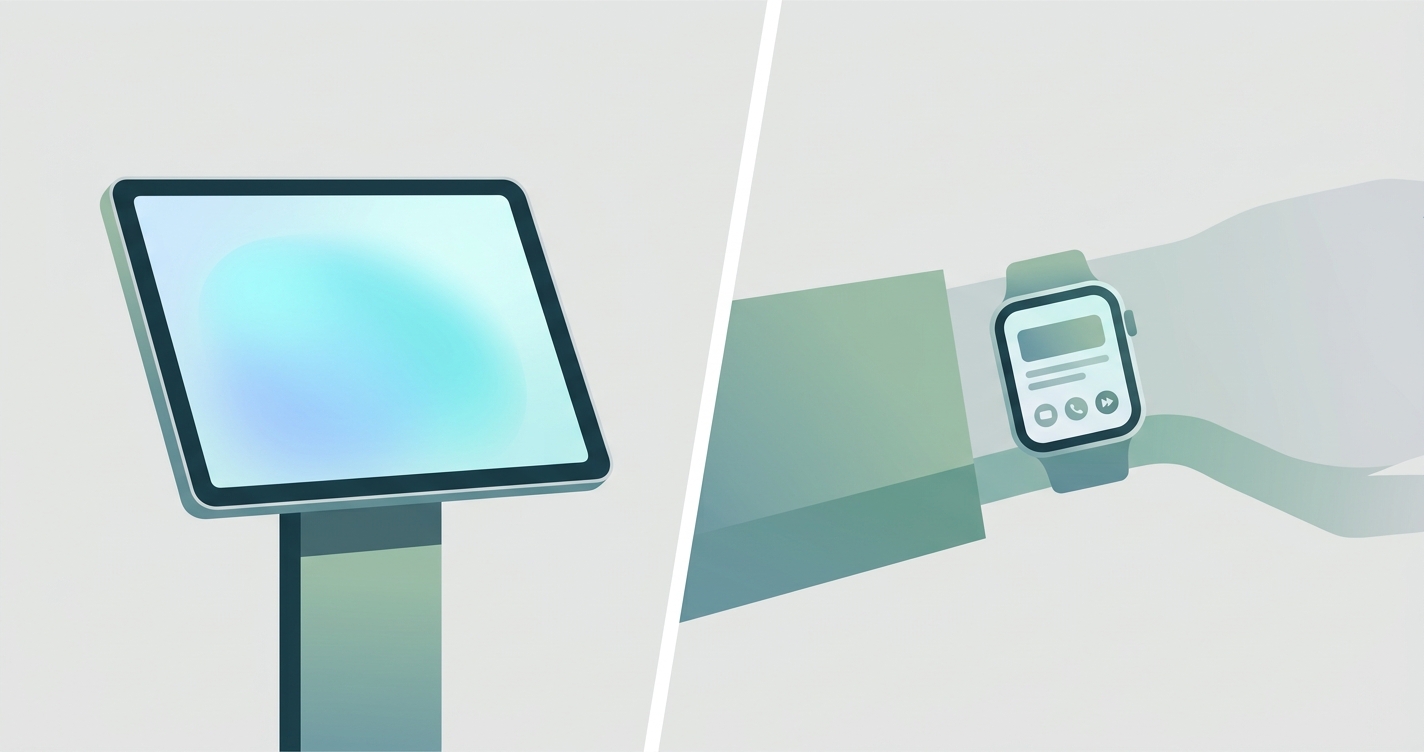
Occupational health teams managing safety-critical crews face a procurement decision that did not exist a decade ago: whether to read worker physiology through a wrist-worn sensor or through a camera that never touches the body. The choice between industrial health screening contactless systems and wearable devices is no longer a question of which technology is more futuristic. It is a question of which model produces reliable pre-shift signals, survives a dusty plant floor, clears hygiene review, and earns the trust of the people being measured. For EHS directors and occupational health providers building fitness-for-duty programs, those four criteria decide whether a deployment scales or stalls.
A 2022 Deloitte survey found that 70 percent of firms implementing wearable fatigue-management systems reported a significant decrease in accidents and injuries, yet only 30 percent of organizations had adopted wearables at all, citing privacy and data-security concerns as the primary barrier.
That gap between proven benefit and actual adoption is the central tension this comparison addresses. The physiological case for measuring crews before a shift is strong. The delivery method is where programs win or lose.
Industrial health screening contactless systems versus wearables
Contactless screening relies on remote photoplethysmography, or rPPG, which extracts pulse and respiration signals from subtle color changes in facial skin captured by a standard camera. A worker stands in front of a tablet or kiosk for roughly 30 to 60 seconds and receives a readout of heart rate, respiration rate, and related markers. Wearables take the opposite approach: a wrist device, ring, or chest strap sits on the body continuously and streams contact-based optical and motion data across an entire shift.
The systematic review of non-contact vision-based vital sign monitoring published in MDPI Sensors (2023) confirmed that camera-based methods can capture heart rate, respiration rate, heart rate variability, blood pressure, and oxygen saturation using only ambient light and standard sensors. The same review noted the honest limits: skin tone, lighting, and gaze direction all influence signal quality, which is why deployment conditions matter as much as the algorithm.
Wearables hold an advantage in continuity. They observe trends across the working day rather than a single gate-side snapshot. The cost of that continuity is friction. Every device must be charged, assigned, cleaned, and worn, and every wrist becomes a data stream that someone must govern.
| Criterion | Contactless face-scan screening | Wearable monitoring |
|---|---|---|
| Measurement window | Point-in-time, pre-shift (30-60 sec) | Continuous across shift |
| Physical contact | None | Direct skin contact |
| Hygiene burden | No shared-surface skin contact | Cleaning and sanitizing between users |
| Hardware per worker | Shared kiosk or tablet | One device per worker |
| Charging and logistics | Centralized, minimal | Daily charge, assignment, replacement |
| Onboarding friction | Walk-up, no fitting | Sizing, pairing, training |
| Privacy footprint | Session-based, no body tracking | Continuous location and activity data |
| Best fit | Gate-side fitness-for-duty checks | Sustained exposure and trend analysis |
What separates the two models in the field
The decision rarely turns on a single specification. It turns on how each model behaves across the four criteria that occupational health buyers consistently raise.
- Reliability of the signal: rPPG validation studies report strong agreement with reference devices for pulse rate. A 2024 clinical validation of contactless pulse rate monitoring in cardiovascular patients reported a mean absolute error of 1.061 beats per minute against ECG, with a Pearson correlation of 0.962. Blood pressure remains the harder problem for both camera and wrist sensors, a limitation researchers across both modalities openly acknowledge.
- Cost structure: wearables carry a recurring per-worker hardware cost plus replacement for loss and damage. Contactless screening concentrates spend in shared kiosks, which lowers the marginal cost of adding workers to a site.
- Hygiene: shared wrist devices require cleaning protocols between users on multi-shift sites. A camera-based check involves no shared skin contact, which removed a meaningful objection during the period when surface transmission dominated workplace health planning.
- Worker buy-in: continuous body tracking triggers the privacy resistance Deloitte and PwC both documented. A point-in-time check at the gate is easier to frame as a safety gate rather than all-day surveillance.
None of this makes wearables obsolete. For roles defined by sustained heat exposure or long-haul fatigue accumulation, continuous data has real diagnostic value. The point is that the two models answer different questions.
Industry Applications
Heavy industry and construction
On sites with rotating crews, contractors, and high worker turnover, the per-device economics of wearables strain quickly. A shared contactless kiosk at the gate handles a fluctuating headcount without sizing, pairing, or device recovery at shift end. This is where wearable-free health screening earns its keep: the program scales with the worker count rather than the device inventory.
Transportation and logistics
Smartwatch fatigue tracking has been marketed heavily to fleet and rail operators, and continuous monitoring suits long-duration driving exposure. Yet pre-shift readiness, the regulatory pressure point for many transport operators, is fundamentally a gate decision. A 30-second contactless vitals scan before a worker takes the controls produces an auditable readiness record without asking drivers to wear a tracker on personal time.
Energy and remote sites
At remote renewable and extraction sites, logistics dominate. Charging, distributing, and recovering wearables across a remote rotation is an operational burden. A self-service screening station that requires only power and connectivity reduces the moving parts a small site health team must manage.
Current research and evidence
The evidence base for both models has matured. On the contactless side, a 2023 study of a smartphone-based rPPG application reported heart rate agreement with a relative mean absolute percentage error of 2.66 percent, with respiration and blood pressure showing wider error margins. A 2024 study of a non-contact PPG mobile application found heart rate mean absolute error of 2.96 beats per minute and oxygen saturation mean absolute error of 2.10 percent, while blood pressure again lagged, with systolic mean absolute error of 14.24 mmHg. The pattern is consistent: pulse and respiration are robust, blood pressure remains a research frontier.
On the wearable side, the workplace literature focuses on outcomes rather than sensor precision. A 2023 study found companies using wearables for fatigue monitoring reported a 30 percent increase in employee engagement, and the National Safety Council has documented wearable fatigue programs in industrial settings. But the same body of work repeatedly flags adoption barriers: 65 percent of EHS decision-makers in one survey cited data privacy as a significant obstacle to industrial wearable deployment.
The research split is instructive. Contactless studies argue about measurement fidelity. Wearable studies argue about adoption and trust. A buyer weighing the two should read both literatures, because the unsolved problems differ by model.
The future of contactless and wearable screening
The two approaches are converging toward complementary roles rather than a winner-take-all outcome. Expect contactless checks to anchor the pre-shift gate, producing the discrete fitness-for-duty record that regulators and safety management systems can ingest. Expect wearables to persist in roles where sustained physiological exposure, such as heat or vibration, demands continuous observation.
Three developments will shape the next several years. First, multi-cohort rPPG validation across skin tones and lighting conditions will determine how widely contactless screening can be trusted at scale. Second, privacy-by-design architectures, where a session readout replaces a continuous body-data stream, will influence which model workers accept. Third, integration with safety management systems will reward whichever model produces clean, structured, point-in-time records that fit existing compliance workflows.
For occupational health providers, the practical takeaway is to match the measurement model to the risk question. A gate decision wants a gate-side tool. A continuous-exposure question wants a continuous tool.
Frequently asked questions
Is contactless screening as reliable as a wearable for pulse measurement? Peer-reviewed validation studies report strong agreement between rPPG-based contactless pulse measurement and reference ECG, with one 2024 study showing a mean absolute error near one beat per minute. Both contactless and wearable methods show wider error margins for blood pressure, so program design should weight the markers each model measures most reliably.
Which is cheaper to deploy across a large crew? Contactless screening concentrates cost in shared kiosks, so the marginal cost of adding workers is low. Wearables carry a recurring per-worker hardware cost plus replacement for loss and damage, which scales with headcount.
Why does worker buy-in favor contactless screening? Continuous wearable monitoring generates all-day activity and location data, which surveys link to privacy resistance among both workers and EHS decision-makers. A point-in-time contactless check at the gate is more readily understood as a safety gate rather than ongoing surveillance.
Can the two approaches be used together? Yes. Many programs use contactless screening for pre-shift fitness-for-duty decisions and reserve wearables for roles with sustained exposure risks such as heat stress, where continuous data adds diagnostic value.
Circadify is building toward this contactless-first model for safety-critical crews, with pre-shift vitals screening and fatigue detection designed for the realities of a plant floor. Occupational health providers evaluating wearable-free health screening can start a contactless screening trial through a safety program inquiry to see how gate-side scanning fits an existing fitness-for-duty program.