Can I discreetly check my health at work without invasive medical procedures?
How industrial health screening contactless methods let workers check vitals privately before a shift without blood draws, cuffs, or stored biometric records.
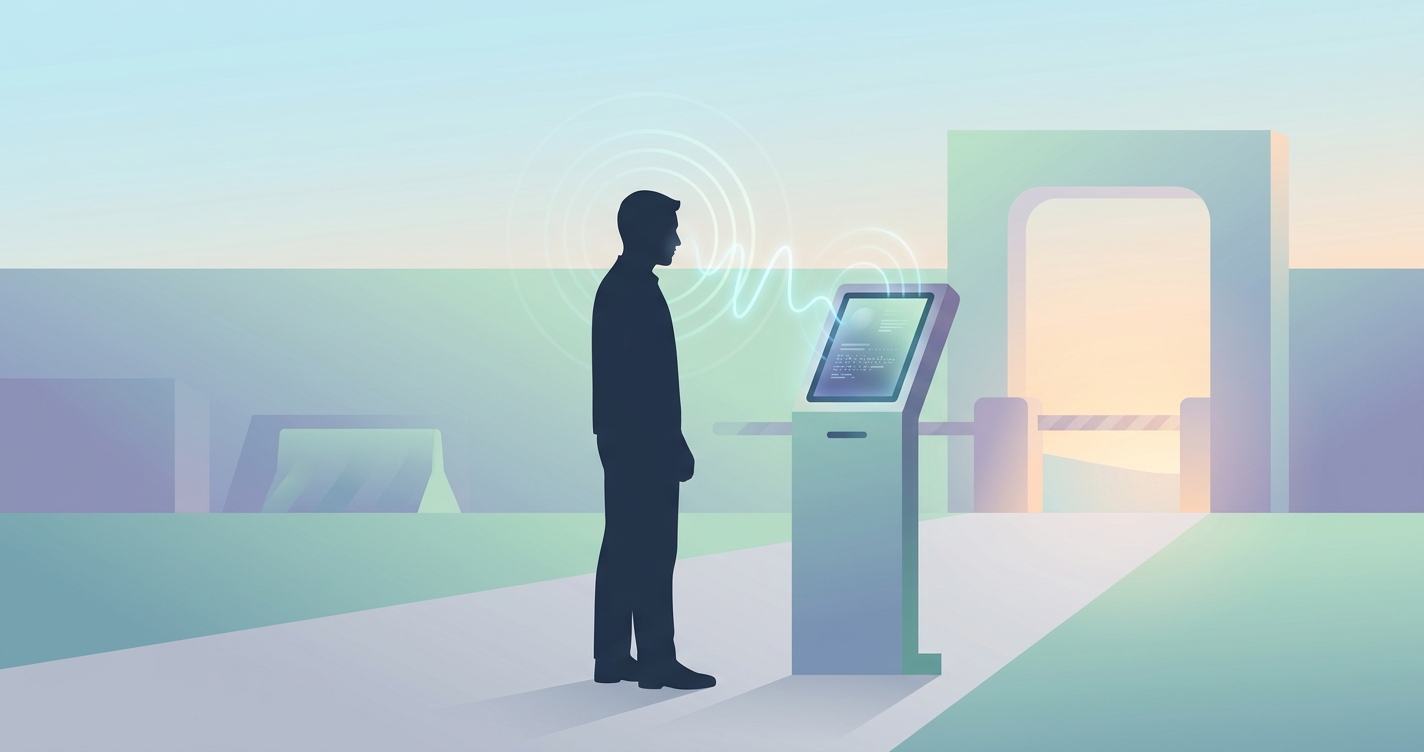
For the worker standing at the gate before a shift, the quiet question is rarely about productivity. It is about dignity. Will checking my readiness mean a needle, a cuff, a cup, or a file that follows me around? For the EHS director on the other side of that gate, the question is mirrored: how do we confirm a worker is fit for the task without turning every morning into a clinical exam that nobody wants to repeat? Industrial health screening contactless methods have emerged precisely at this intersection, offering a way to read physiological readiness without touching the body and, increasingly, without retaining the kind of identifiable medical record that triggers both legal exposure and employee resentment.
A 2024 systematic review of non-contact vision-based vital sign monitoring published in MDPI's Sensors reported camera-based heart rate measurement accuracy exceeding 99 percent under controlled conditions, alongside oxygen saturation estimates in the 93 to 95 percent range, positioning contactless capture as a credible screening signal rather than a novelty.
What industrial health screening contactless technology actually measures
The core technology behind most contactless approaches is remote photoplethysmography, or rPPG. A standard camera detects subtle color changes in facial skin caused by blood flowing beneath the surface with each heartbeat. From that signal, software can estimate heart rate, heart rate variability, respiratory rate, and in some implementations an oxygen saturation indicator. None of it requires contact, a cuff, a finger clip, or a sample. The worker looks at a device for roughly half a minute and receives a readiness indicator, not a diagnosis.
This distinction matters for the privacy conversation. Traditional fitness-for-duty checks often rely on procedures that feel invasive precisely because they are: phlebotomy for blood markers, breath samples for substances, or blood pressure cuffs that require physical handling. Contactless screening reframes the interaction as an environmental reading rather than a medical procedure. The worker is not poked, swabbed, or restrained. For a workforce that already associates screening with suspicion, that shift in framing changes participation rates and trust.
Importantly, researchers continue to document the limits. The same body of work that praises rPPG heart rate accuracy notes that performance can degrade with elevated heart rates, poor lighting, motion, and across skin tones. A 2024 analysis covered by News-Medical found accuracy of remote photoplethysmography drops sharply at elevated heart rates, a reminder that contactless capture is a screening layer, not a replacement for clinical assessment when a flag appears.
How contactless screening compares to traditional methods
The practical question for an EHS director is not whether contactless is perfect, but how it stacks up against the alternatives a worker might otherwise face at the gate.
| Screening method | Invasiveness | Privacy / data footprint | Time per worker | Best use |
|---|---|---|---|---|
| Contactless camera (rPPG) | None; no physical contact | Low if vitals are scored and not stored as identifiable medical records | 30 to 60 seconds | High-volume pre-shift readiness checks |
| Blood pressure cuff | Moderate; physical contact and handling | Moderate; creates a measured medical data point | 2 to 5 minutes | Targeted follow-up after a flag |
| Breath or saliva sampling | Moderate to high; bodily sample | High; substance result is sensitive medical data | 3 to 8 minutes | Cause-based or regulated testing |
| Blood draw / lab panel | High; needle and sample | High; clinical record retained | 10+ minutes plus lab turnaround | Periodic medical surveillance |
| Wearable continuous monitor | Low contact but persistent | High; continuous biometric stream raises EEOC scrutiny | Continuous | Long-term physiological trending |
A few patterns stand out for safety leaders weighing options:
- Contactless methods carry the lowest invasiveness and, when configured to output a pass or refer indicator rather than raw stored vitals, the lightest data footprint.
- The methods workers find most objectionable, blood draws and bodily samples, are also the ones that generate the most legally sensitive records.
- Wearables, often assumed to be the privacy-friendly choice, actually drew specific 2024 EEOC attention because continuous biometric streams can constitute ongoing medical inquiry.
Industry Applications
High-volume gate screening
In mining, logistics, and manufacturing, hundreds of workers may pass through a single entry point within a tight window. A contactless station that completes a reading in under a minute keeps the line moving while flagging only the small subset who need a human follow-up. The worker who passes never experiences a medical procedure at all, which preserves both throughput and goodwill.
Privacy-sensitive and unionized workforces
Where collective bargaining agreements or strong privacy cultures make invasive testing contentious, the contactless model offers a negotiating path. Because the interaction reads transient physiological signals rather than collecting samples, programs can be designed so that no persistent identifiable health record is created. That design choice directly addresses the confidentiality obligations the Americans with Disabilities Act places on employers, which require medical information to be kept confidential and separate from personnel files.
Remote and lone-worker sites
Renewable energy fields, pipelines, and remote construction sites rarely have an on-site nurse. A contactless self-check that runs on a tablet or kiosk lets a worker confirm readiness without traveling to a clinic, extending a layer of oversight to locations where traditional screening is logistically impossible.
Current research and evidence
The evidence base for contactless vitals has matured quickly. The 2024 MDPI Sensors systematic review of non-contact vision-based techniques consolidated dozens of studies showing strong heart rate agreement and usable respiratory and oxygen estimates. A separate clinical validation of rPPG-enabled pulse rate software in cardiovascular disease patients, published in the National Library of Medicine, found the approach viable in a population that is harder to read than healthy adults, an encouraging signal for industrial settings where workers vary widely in age and fitness.
On the legal and privacy side, 2024 brought sharper guidance. The EEOC issued wearable-device guidance clarifying that continuous biometric collection can amount to a disability-related inquiry, subject to ADA limits. Employment counsel including Parker Poe documented how biometric screening programs have generated ADA and Title VII claims when consent and confidentiality were mishandled. The Genetic Information Nondiscrimination Act adds a further constraint, barring employers from collecting or using genetic information in employment decisions. The throughline for EHS leaders is consistent: the less identifiable health data a program retains, the smaller its compliance surface. Contactless screening that scores readiness without storing a clinical record aligns naturally with that principle, though program design and worker consent still determine whether a deployment is defensible.
State biometric laws sharpen the point further. Statutes in Illinois, Texas, and Washington impose notice and consent requirements on the capture of facial and other biometric identifiers, so any camera-based deployment must be paired with clear disclosure and a documented consent process.
The future of industrial health screening contactless methods
Three trajectories are visible. First, accuracy under real-world conditions is improving as deep learning models are trained on motion, variable lighting, and diverse skin tones, narrowing the gap that current research honestly flags. Second, privacy-by-design is becoming a feature rather than an afterthought, with systems engineered to output a readiness decision while discarding the underlying signal, reducing what regulators would consider a retained medical record. Third, integration with safety management systems will let a flag at the gate trigger a discreet, human-led follow-up rather than a public event, preserving the worker's dignity while still capturing the safety benefit.
The destination is a screening model that workers experience as fast, private, and respectful, and that EHS directors experience as defensible and operationally light. Contactless capture is the mechanism that makes both possible at the same time.
Frequently asked questions
Can a contactless check at work read my health without storing my medical data? It can be designed that way. Contactless systems read transient signals like heart rate and respiration from a camera and can be configured to output only a pass or refer result, discarding the raw vitals. Whether a specific program stores data depends on its configuration, so workers should ask how results are retained and employers should document that choice to align with ADA confidentiality rules.
Is contactless screening accurate enough to rely on? Research shows strong accuracy for heart rate and usable estimates for respiration and oxygen under good conditions, but accuracy degrades with motion, poor lighting, and very elevated heart rates. For that reason it is best used as a first-pass screening layer that flags workers for a human follow-up, not as a standalone diagnosis.
Do I have to consent to a camera-based health scan at work? In many jurisdictions, yes, consent is required. State biometric laws such as those in Illinois, Texas, and Washington mandate notice and consent for capturing facial data, and federal ADA and GINA rules constrain how employers collect and use health information. A well-run program provides clear disclosure and a documented consent process.
How is contactless screening less invasive than a breathalyzer or blood test? Contactless methods involve no physical contact, no bodily sample, and no needle. The worker simply looks at a device for under a minute. Breath, saliva, and blood-based methods require a sample that many workers find intrusive and that generates a sensitive medical record, whereas a contactless readiness check can avoid both.
Circadify is building toward this exact balance of worker comfort, data minimization, and safety oversight, designing pre-shift screening that reads readiness without invasive procedures or unnecessary record retention. EHS leaders evaluating how contactless screening could fit their safety program can start a safety program inquiry to discuss requirements and deployment.