What if my health condition puts my coworkers at risk without me knowing?
How undiagnosed conditions create shared risk on safety-critical sites, and why early detection protects the whole crew, not just the individual.
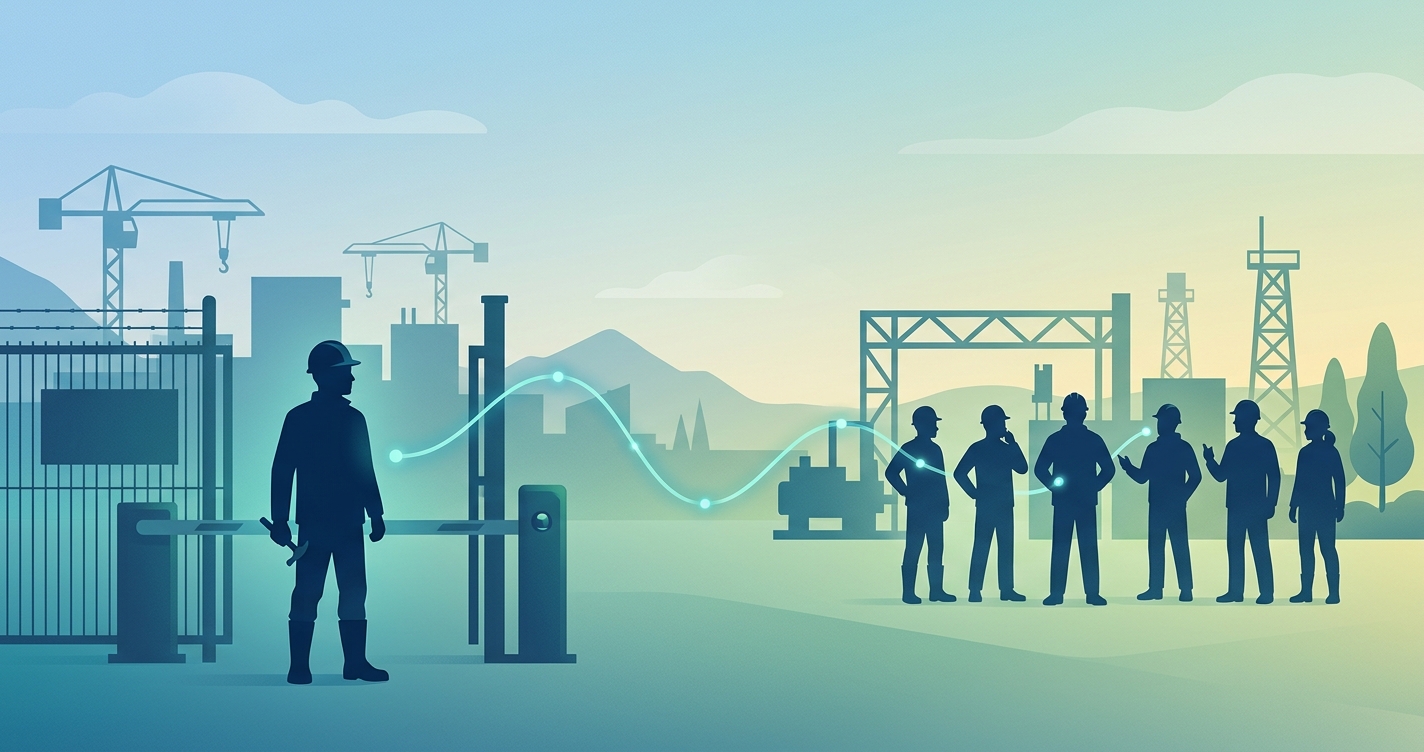
The most uncomfortable question in occupational safety is rarely about a known hazard. It is about the hazard nobody can see, including the worker carrying it. A heart rhythm that has never been flagged, blood pressure trending toward a crisis, or a sleep disorder that quietly steals reaction time can all turn a single person's private medical situation into a shared operational risk. For anyone managing a safety-critical workforce health program, this is the core of proactive risk management: the recognition that individual physiology and collective safety are the same problem viewed from two angles. A worker who feels "fine" can still be a few minutes away from an event that endangers the people working beside them.
A University of Minnesota study led by Stephen V. Burks found that commercial drivers with untreated obstructive sleep apnea experienced roughly 70 preventable serious crashes per 1,000 drivers per year, compared with about 14 for both treated drivers and a control group. The difference between knowing and not knowing was a five-fold change in crash risk.
Why safety-critical workforce health is a communal problem
In most workplaces, a health condition is a personal matter with personal consequences. On a safety-critical site, the math changes. When one operator controls a haul truck, a press, a crane, or a rail consist, their momentary incapacitation becomes everyone's emergency. This is why safety-critical workforce health cannot be framed only as an employee wellness benefit. It is a system property of the worksite, and it behaves like any other shared hazard: it concentrates risk at the exact moment when margins are thinnest.
The challenge is that the conditions most likely to cause sudden incapacitation are often the ones least likely to announce themselves. Hypertension is frequently called a silent condition because symptoms appear late. Obstructive sleep apnea degrades alertness gradually, so the affected person normalizes their own impairment. Cardiac arrhythmias can be intermittent. None of these announce a clear "do not work today" signal to the person experiencing them, which is precisely why the burden of detection cannot rest on self-reporting alone.
A useful reference point comes from the transportation medicine literature. Researchers synthesizing fitness-for-duty thresholds have proposed a 1 percent annual risk of sudden incapacitation as an accepted ceiling for safety-critical roles. That figure reframes the entire conversation. The question is not whether a worker feels capable. It is whether the system can keep the probability of an unseen event below a tolerable line.
| Risk management approach | What it detects | Coworker protection | Limitation |
|---|---|---|---|
| Self-reporting before a shift | Symptoms the worker recognizes | Low, depends on awareness and honesty | Silent conditions go unreported |
| Annual medical exam | Conditions present on exam day | Moderate, but point-in-time | Misses changes between exams |
| Wearable continuous monitoring | Ongoing physiological trends | Moderate to high | Adoption, comfort, data overload |
| Pre-shift contactless vitals screening | Daily baseline deviations | High, applied to whole crew | Requires consistent program design |
| Incident investigation | Causes after an event | None, fully reactive | Protection only for future shifts |
The table makes one pattern clear. Approaches that protect coworkers most are the ones applied consistently across the entire crew and close to the moment of risk, rather than once a year or only after something has gone wrong.
How invisible conditions translate into shared risk
The mechanics of how a private condition becomes a collective hazard tend to follow a few recurring paths:
- Sudden incapacitation, where a cardiac or neurological event removes the operator's control entirely.
- Gradual impairment, where fatigue, untreated apnea, or rising blood pressure erodes judgment and reaction time without a clear onset.
- Cascading failure, where one impaired worker's mistake forces nearby workers into emergency responses they were not prepared for.
- Delayed recognition, where coworkers notice something is wrong only after the window to intervene has closed.
Each path shares a common feature. The worker at the center is usually the last to know. That is the structural reason early detection matters more in shared environments than in isolated ones. A condition caught at the gate is a medical referral. The same condition caught mid-shift can be a multi-casualty incident.
Industry applications of early detection
Heavy equipment and manufacturing
Operators of mobile equipment and high-energy machinery represent the clearest case. A brief loss of consciousness behind the controls of a forklift or press endangers everyone in the operating radius. Pre-shift screening that flags abnormal heart rate, blood pressure, or signs of acute fatigue gives the safety team a chance to reassign or refer a worker before they ever touch the controls.
Transportation and rail
Commercial driving and rail operations have driven much of the research on this topic, partly because the consequences extend beyond the worksite to the public. The Federal Motor Carrier Safety Administration has long examined obstructive sleep apnea as a fitness-for-duty concern. Stephen Tregear's systematic review for the agency placed the crash-rate ratio for drivers with sleep apnea between 1.21 and 4.89, a range wide enough to demand screening rather than assumption.
Energy, mining, and remote sites
In remote or high-consequence environments, the absence of immediate medical response amplifies the cost of any missed condition. A worker whose hypertension goes undetected at a remote wind farm or mine site is hours from definitive care. Here, early detection is About preventing an incident. About avoiding a situation no on-site responder can manage.
Current research and evidence
The evidence base for treating individual health as a collective safety variable continues to strengthen. The Burks study at the University of Minnesota remains a reference point because it quantified the protective effect of detection and treatment so cleanly: drivers who complied with apnea therapy returned to a crash rate indistinguishable from drivers without the condition. Detection plus action erased most of the excess risk.
Broader occupational data adds context. The U.S. Bureau of Labor Statistics reported 2.5 million nonfatal workplace injuries and illnesses across private industry in 2024, alongside hundreds of workplace fatalities recorded by OSHA. While not all of these trace to undiagnosed conditions, the sudden-incapacitation literature suggests a meaningful share of high-severity events involve a physiological state that was present, but unrecognized, before the shift began.
The transportation medicine synthesis recommending a 1 percent annual incapacitation threshold also matters because it provides a defensible target. Programs can be designed around a measurable acceptable-risk line rather than vague reassurance. That shift, from subjective readiness to quantified probability, is what separates modern fitness-for-duty thinking from older self-attestation models.
The future of safety-critical workforce health
The direction of travel is toward continuous, low-friction, and crew-wide detection. Several developments point this way:
- Contactless measurement that captures vitals in seconds without disrupting the shift start, lowering the adoption barrier that limited earlier screening efforts.
- Trend-based analysis that compares each worker against their own established baseline rather than a single population threshold, improving sensitivity to early change.
- Integration with safety management systems, so a flagged reading triggers a documented workflow rather than an informal judgment call.
- Privacy-by-design architecture, which addresses the legitimate concern that health screening could become surveillance rather than protection.
The unifying theme is that detection is moving closer to the moment of risk and being applied evenly across the whole crew. That is the only configuration that meaningfully answers the question a worker cannot answer for themselves: am I, right now, a risk to the people next to me?
Frequently asked questions
Can my employer really detect a condition I do not know I have?
Pre-shift screening does not diagnose disease. It detects deviations in measurable signs such as heart rate, heart rate variability, and blood pressure indicators that fall outside a worker's normal range. An abnormal reading is a prompt for follow-up with a medical provider, not a diagnosis on its own, but it can surface a problem before symptoms ever appear.
Why is my individual health treated as a workplace safety issue?
In safety-critical roles, one person's sudden incapacitation can injure others or trigger a larger incident. Researchers in transportation medicine often use a 1 percent annual sudden-incapacitation threshold to define acceptable risk, which reframes personal health as a shared safety variable on high-consequence sites.
Does early detection actually reduce risk for coworkers?
The evidence suggests yes. The University of Minnesota study on commercial drivers found that detecting and treating obstructive sleep apnea brought crash rates back in line with unaffected drivers, effectively removing the elevated risk that the untreated condition created for everyone on the road.
Is screening for hidden conditions an invasion of privacy?
It depends entirely on program design. Modern approaches favor contactless measurement, baseline comparison, and clear data governance so that screening protects workers without becoming open-ended surveillance. The goal is a documented, consistent safety control, not access to personal medical histories.
Circadify is building toward this model of shared protection, developing pre-shift contactless vitals screening designed to surface the invisible conditions that put crews at risk before a shift begins. Safety leaders evaluating how early detection fits their program can start a safety program inquiry to explore the approach.