
Heat Stress Monitoring With Contactless Vitals: How to Set It Up
A research-style report for EHS directors on setting up heat stress monitoring programs using contactless vitals technology to mitigate risk in industrial environments.
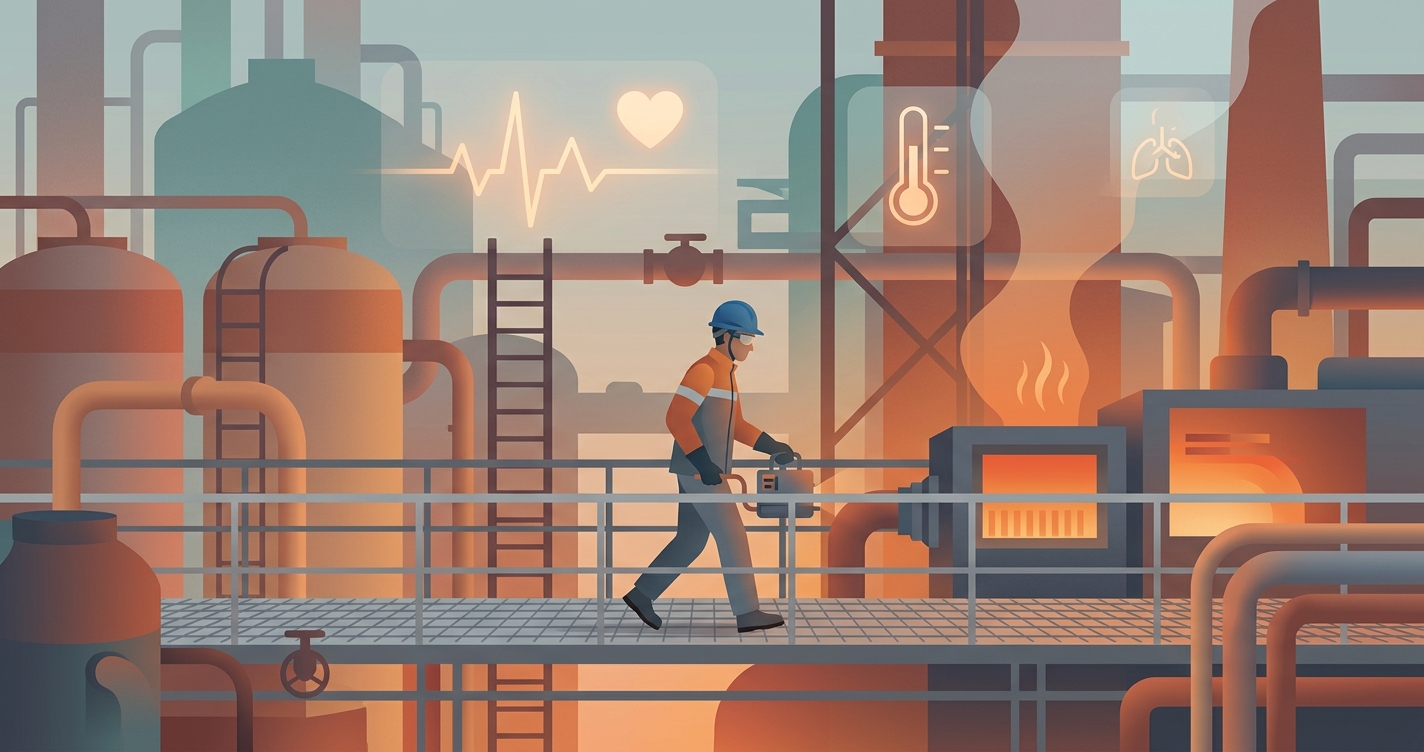
The increasing frequency of extreme heat events presents a direct and escalating threat to industrial worksites. For Environmental, Health, and Safety (EHS) directors, managing the physiological strain on workers is no longer a seasonal or regional concern, but a core component of a proactive safety strategy. Traditional methods of environmental monitoring and administrative controls are often insufficient to prevent individual-level heat stress incidents. The physiological response to heat is highly variable, depending on an individual's acclimatization, health status, and hydration. This variability necessitates a move toward personalized, real-time monitoring. The emergence of heat stress monitoring with contactless vitals offers a scalable, non-intrusive solution to identify at-risk workers before their core body temperature reaches a critical threshold, enabling timely interventions and preventing serious injury.
"Globally, over 2.4 billion workers are exposed to excessive heat, leading to more than 22.85 million occupational injuries each year." - World Health Organization (2023)
The core challenge of heat-related illness
Heat stress occurs when the body cannot get rid of excess heat, causing the core body temperature to rise and the heart rate to increase. If not addressed, it can progress to heat exhaustion and then to heatstroke, a life-threatening condition. The U.S. Occupational Safety and Health Administration (OSHA) is actively developing a national standard for workplace heat exposure, signaling a major regulatory shift that will require employers to implement more robust prevention programs. A 2023 study published in the journal Environmental Health Perspectives found that high heat contributes to at least 27,953 excess workplace injuries annually in the United States, a figure that does not even include direct heat-related illnesses. The core challenge for EHS directors is identifying which workers are becoming dangerously strained in real-time. This is where heat stress monitoring contactless vitals technology provides a significant operational advantage. By measuring key physiological indicators without physical contact, these systems can provide continuous insight into a worker's condition.
Comparing heat stress monitoring methodologies
The primary goal of any heat stress monitoring program is to prevent a worker's core body temperature from rising to dangerous levels. Various technologies and methods are available, each with distinct operational models.
| Feature | Traditional Monitoring (WBGT) | Wearable Sensors | Contactless Vitals Monitoring |
|---|---|---|---|
| Primary Measurement | Environmental conditions (temperature, humidity, radiant heat) | Individual physiological data (e.g., skin temp, heart rate) | Individual physiological data (e.g., heart rate, respiratory rate) |
| Implementation | Area monitoring equipment | Devices worn by each worker (watches, patches, smart clothing) | Kiosk or camera-based scanning at checkpoints |
| Worker Burden | Low; no individual equipment | High; requires charging, maintenance, and consistent use | Very Low; requires a brief, passive scan |
| Data Granularity | General area risk; not individualized | High; continuous individual data | High; individual data at specific points in time |
| Scalability | Easy to scale for large areas | Challenging and costly to scale for large workforces | Highly scalable; one device can screen many workers |
| Intervention Trigger | Environmental threshold is met | Individual physiological threshold is met | Individual physiological threshold is met |
Key physiological indicators for heat stress that can be monitored include:
- Elevated Heart Rate
- Increased Respiratory Rate
- Core Body Temperature (often estimated from other vitals)
- Heart Rate Variability (HRV)
Industry applications for contactless screening
Construction and infrastructure
On construction sites, workers are often exposed to direct sun with few opportunities for relief. A contactless vitals kiosk at the site entrance for pre-shift screening can identify workers who may be starting their shift already dehydrated or with elevated baseline vitals. Another scan during a mandatory lunch break can flag individuals who are not recovering adequately.
Manufacturing and warehousing
In large manufacturing plants or distribution centers, indoor temperatures can soar, especially in areas with heat-producing machinery. Integrating heat stress monitoring contactless vitals scanners at time clocks or entry points to specific high-heat zones allows for automated, systematic checks without disrupting workflow.
Oil and gas operations
For the oil and gas sector, particularly in remote or offshore locations, the physical demands are immense. Using contactless systems to screen workers before they enter confined spaces or perform physically strenuous tasks provides a critical layer of safety, ensuring they are fit for the immediate duty.
Current research and evidence
The field of contactless vital signs monitoring is advancing rapidly. Research from institutions like the Massachusetts Institute of Technology (MIT) has demonstrated the ability to accurately measure heart rate and respiratory rate from a distance using cameras and advanced signal processing. A 2021 study led by researcher John A. Stankovic at the University of Virginia explored the use of unobtrusive sensors for health monitoring, highlighting the potential for camera-based systems to detect changes in physiological state. While the direct measurement of core body temperature remains a challenge for all non-invasive methods, researchers are developing sophisticated algorithms that correlate changes in heart rate, respiratory rate, and subtle skin temperature variations to accurately estimate thermal strain. The National Institute for Occupational Safety and Health (NIOSH) continues to evaluate these emerging technologies as part of its Criteria for a Recommended Standard on occupational heat stress.
The future of heat stress monitoring
The future of heat stress monitoring with contactless vitals lies in its integration with broader EHS platforms. Expect to see systems that combine individual physiological data with real-time environmental data (like Wet Bulb Globe Temperature) and even worker-specific data, such as acclimatization status and recent shift history. This will allow for the creation of predictive risk models that can alert a safety manager before a worker's condition becomes critical. As the technology becomes more refined, it will move from being a reactive tool to a proactive, predictive one, fundamentally changing how industrial sites manage heat-related risk.
Frequently asked questions
Q: How does contactless vital sign monitoring work for heat stress? A: These systems typically use a camera or other optical sensors to detect subtle, involuntary changes in the skin's surface caused by blood flow. Advanced algorithms then analyze this video feed to calculate vital signs like heart rate and respiratory rate. An elevated reading can be an early indicator of heat strain.
Q: Is this technology a replacement for traditional heat safety measures? A: No. Contactless monitoring is a powerful addition to a comprehensive heat illness prevention plan. It should be used in conjunction with established best practices like providing water, rest, and shade, as well as acclimatizing workers and training them to recognize the symptoms of heat illness.
Q: What are the main advantages of a contactless approach over wearables? A: The primary benefits are logistical simplicity and lower worker burden. There are no devices to charge, distribute, or maintain. A single kiosk can screen hundreds of workers per day without requiring them to wear anything, making it highly scalable for large industrial sites.
Q: How do you implement a contactless monitoring program? A: Implementation typically involves placing a scanning kiosk at a key chokepoint, like a site entrance or breakroom. Workers undergo a brief, passive scan as part of their daily routine (e.g., when clocking in). The system flags any individuals with readings outside of a pre-defined normal range for a secondary check or intervention by a supervisor.
By using technologies for heat stress monitoring contactless vitals, EHS directors can add a crucial layer of individualized, data-driven protection to their safety programs. Circadify is at the forefront of developing these advanced screening solutions to help industrial operators protect their most valuable asset: their people. To learn more about building a proactive health screening program, explore our solutions at circadify.com/solutions/fraud-detection.