How do companies know if I'm truly ready for my 6 AM shift without a doctor's note?
How occupational health screening technology delivers objective pre-shift readiness for safety-critical workers without paperwork, doctor visits, or invasive exams.
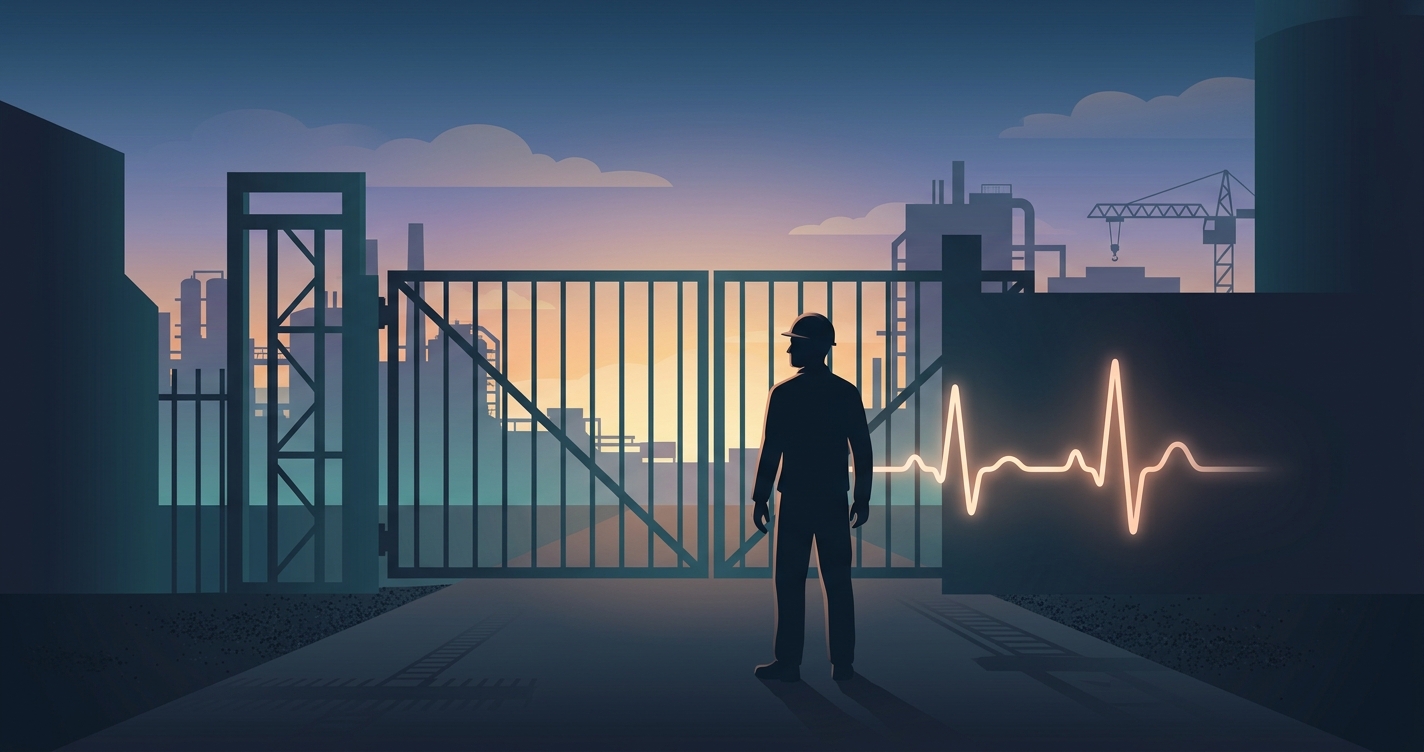
The 6 AM start is one of the most dangerous moments in any safety-critical operation. A worker arrives after a short night of sleep, a long commute, and a body clock that has not yet caught up to the task ahead. The supervisor has minutes, not hours, to decide whether that person can safely run a crane, a haul truck, or a control panel. Traditional fitness-for-duty checks were never built for this window. A doctor's note confirms a condition that existed days or weeks earlier; it says nothing about whether someone is alert right now. This gap is exactly where occupational health screening technology has started to reshape how readiness gets verified at the gate, replacing slow paperwork with objective, same-morning data.
Folkard, Lombardi, and Spencer (2006) estimated that the relative risk of a workplace accident runs roughly 30 percent higher on night and early-morning shifts than on day shifts, with alertness bottoming out between 2 AM and 6 AM.
What occupational health screening technology actually measures
The phrase fitness-for-duty has historically meant a clinical exam: a clinic visit, a physician sign-off, and a file in a folder. That model answers a medical question but not an operational one. An EHS director does not need to know whether a worker has a chronic condition managed by their own physician. They need to know whether this specific person, on this specific morning, shows objective signs of impairment that raise risk for the crew.
Occupational health screening technology reframes the question around current physiological state rather than historical medical status. Instead of a doctor's note, the worker completes a short, structured check that captures objective signals tied to readiness. According to the National Institute for Occupational Safety and Health (NIOSH), fatigue and nonstandard schedules are persistent contributors to workplace injury, and the agency's Center for Work and Fatigue Research has called for detection methods that are practical and unobtrusive enough for daily use.
The signals that correlate with readiness include:
- Heart rate and heart rate variability, which shift with sleep debt and circadian misalignment
- Respiratory rate, an indicator of physiological stress and recovery state
- Reaction time, often measured through a brief Psychomotor Vigilance Test (PVT) that flags cognitive slowing
- Resting cardiovascular trends that deviate from a worker's own established baseline
None of these require a needle, a clinic, or a wait. The point is not diagnosis. It is a same-morning, objective answer to a same-morning operational question.
How modern screening compares to the doctor's note model
The contrast between traditional clearance and current screening approaches is sharpest when you line them up against the demands of a pre-shift window.
| Factor | Doctor's note / clinical exam | Periodic wearable program | Pre-shift screening technology |
|---|---|---|---|
| What it confirms | Medical status at a past date | Trends over days or weeks | Readiness this morning |
| Timing | Days to weeks in advance | Continuous, off-site | Seconds, at the gate |
| Detects acute fatigue | No | Partially | Yes |
| Worker burden | Clinic visit, paperwork | Wear and charge a device | Brief station check |
| Privacy exposure | Full medical record | Continuous tracking | State signals only |
| Cost per check | High | Moderate, recurring | Low, per shift |
| Fits a 6 AM start | No | No | Yes |
The doctor's note is not obsolete. It remains the right tool for diagnosing and managing health conditions. But it was never designed to answer whether someone is too tired to operate machinery at dawn. That is a different question with a different time horizon, and screening technology is built specifically for it.
Industry applications
Mining and heavy construction
These sites run rotating and extended shifts in remote locations where a clinic is hours away. A gate-based readiness check gives supervisors an objective basis for a conversation before a worker climbs into equipment, rather than a judgment call based on appearance alone.
Transportation and rail
Operators face strict fatigue rules and overnight runs that hit the circadian low point. Objective pre-shift signals support fatigue risk management programs without forcing drivers through a medical appointment before every shift.
Manufacturing and processing
Plants with 12-hour shifts carry roughly double the safety risk of an 8-hour shift, a pattern documented across the shift-work literature. Brief screening at line entry helps catch the workers most affected by sleep loss before they reach a hazard.
Energy and utilities
Control-room and field roles demand sustained vigilance where a single lapse carries outsized consequences. Readiness data adds an objective layer to existing fitness-for-duty policy without expanding bureaucratic overhead.
Current research and evidence
The evidence base for objective readiness assessment has grown quickly. Folkard, Lombardi, and Spencer (2006), in their analysis of injury risk across the night shift, established the now widely cited finding that accident risk climbs steadily through the night and peaks in the early-morning hours. This work, hosted through CDC Stacks, remains a foundation for why the 6 AM window deserves special attention.
More recent reviews of wearable and AI-based fatigue monitoring, including 2024 syntheses of multimodal sensing, report that combining physiological signals such as heart rate, motion, and cardiac variability improves the reliability of fatigue estimates over any single measure. Researchers in this area also flag a consistent theme: the systems that succeed in the field are the ones that workers will actually use, meaning fast, low-friction, and respectful of privacy.
Cognitive testing reinforces the physiological picture. The Psychomotor Vigilance Test, long used in sleep research, gives a direct behavioral readout of alertness and has been adapted into brief pre-shift formats. NIOSH's own science communications on setting objectives for fatigue detection technologies emphasize that the goal is not to label individuals but to manage risk at the point where exposure begins. Drowsy-driving research adds urgency at the other end of the shift: studies of near-crash events show degraded driving performance among night-shift workers commuting home, underlining that readiness is a full-cycle concern.
A practical caution runs through the literature. Single readings can mislead, which is why baseline-relative interpretation matters. A heart rate that is high for one worker may be normal for another, so the most useful screening compares a person against their own established pattern rather than a population average.
The Future of occupational health screening technology
Three shifts are likely over the next several years. First, contactless capture. Camera-based and remote photoplethysmography methods can read cardiovascular signals without contact, removing the friction of devices and shared sensors and making a gate-side check take seconds. Second, integration. Readiness scores will flow directly into safety management systems, so a flagged result triggers a documented protocol rather than an informal chat. Third, predictive framing. As circadian modeling and heart-rate-variability research mature, screening will move from detecting current fatigue toward anticipating risk windows before a shift even begins.
The regulatory and privacy frame will mature alongside the technology. The durable designs will be those that measure state signals tied to the job, keep medical records separate, and give workers transparency about what is captured and why. Objective data, handled with restraint, is what turns a subjective gate decision into a defensible safety practice.
Frequently asked questions
Does pre-shift screening replace a doctor's exam? No. Clinical exams diagnose and manage health conditions. Pre-shift screening answers a narrower operational question: does a worker show objective signs of impairment or fatigue this morning. The two serve different purposes and can coexist.
Can technology really tell if I am too tired without a blood test? Yes, indirectly. Sleep debt and circadian misalignment change measurable signals such as heart rate variability, respiratory rate, and reaction time. A brief check of these markers, especially compared against your own baseline, can flag elevated fatigue risk without any blood draw.
Is this just surveillance of my private health? Well-designed programs capture state signals relevant to readiness, not a continuous medical record. The objective is risk management at the start of a shift, and the most defensible systems keep screening data separate from clinical files and are transparent about what they measure.
Why focus on the 6 AM shift specifically? Research dating to Folkard, Lombardi, and Spencer (2006) shows accident risk peaks in the early-morning hours when alertness is lowest. The 6 AM start often follows insufficient sleep and a circadian trough, making it one of the highest-risk windows of the day.
Circadify is addressing this space directly, building contactless pre-shift screening that gives safety teams an objective, non-bureaucratic readiness signal without clinic visits or paperwork. EHS directors and industrial safety managers evaluating how to close the dawn-shift gap can start a safety program inquiry at circadify.com/solutions/fraud-detection.