Occupational Health Providers: Add Health Screening Tech
How occupational health providers can add contactless screening as a recurring service for industrial clients, with market data, models, and partnership pathways.
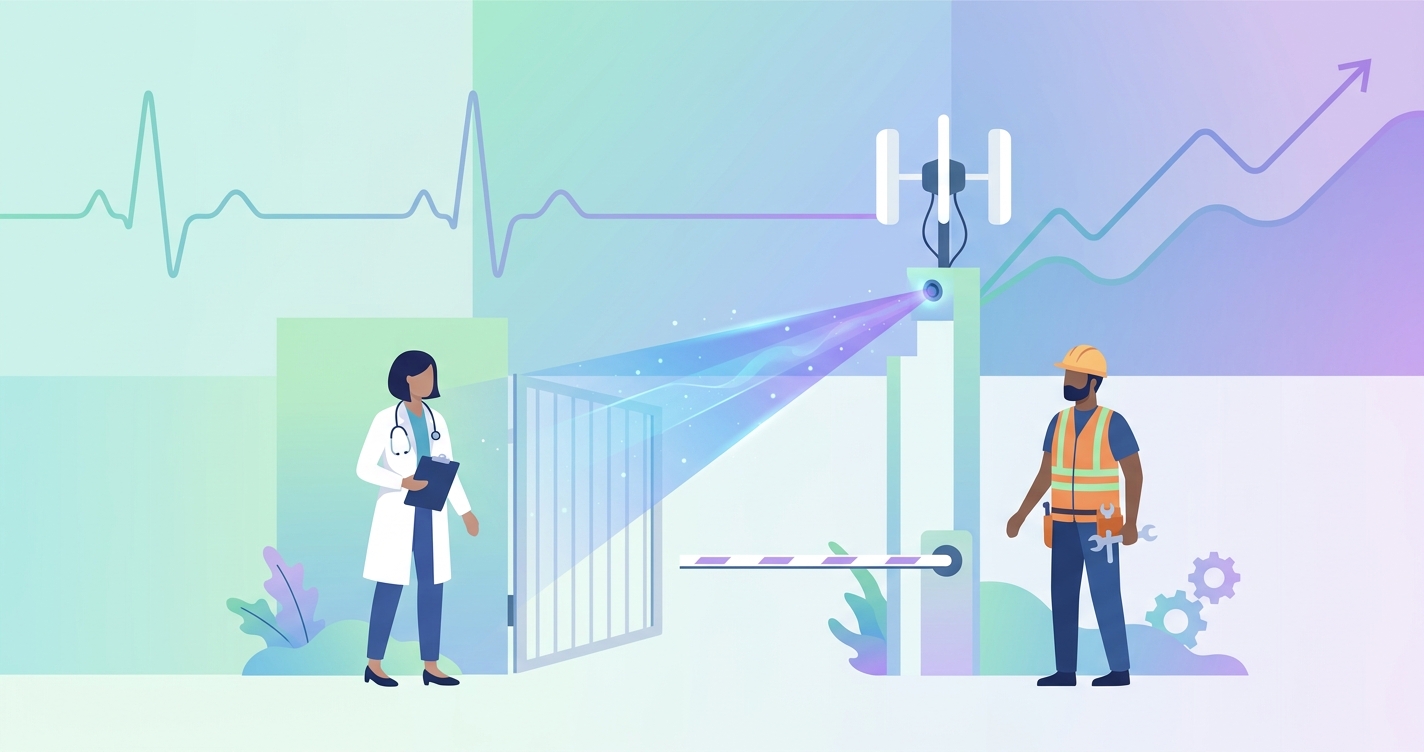
Occupational health providers sit on an underused asset: standing relationships with industrial employers who already buy physicals, drug panels, and audiometric testing on recurring contracts. The fastest-moving expansion path for those relationships in 2026 is occupational health screening technology that reads worker physiology without contact, turning a once-a-year clinical event into a daily, worksite-level service line. For clinics weighing where to invest next, contactless pre-shift screening offers a way to enter the worksite itself rather than waiting for workers to walk through the clinic door.
The global occupational health services market reached an estimated USD 39.78 billion in 2024 and is projected to climb to USD 62.48 billion by 2035, with on-site services capturing roughly 35 percent of activity in 2025, according to Market Research Future (2024).
That on-site share matters. The growth is not in more clinic visits; it is in services that move to where the work happens. Providers who can deliver screening at the gate, not just the exam room, are positioned to capture the part of the market that is actually expanding.
Why occupational health screening technology is a service-line opportunity
Traditional occupational health revenue is episodic. A new hire gets a baseline exam, an injured worker gets a return-to-work evaluation, and a contract renews annually. Contactless occupational health screening technology changes the cadence. Camera-based systems using remote photoplethysmography (rPPG) estimate heart rate, respiratory rate, and related cardiovascular signals from a short facial scan, which means a screening can happen every shift instead of every year.
For an industrial client, the appeal is fitness-for-duty and fatigue context delivered before a worker touches heavy equipment. For the provider, the appeal is a recurring, per-worker or per-site service that layers on top of existing contracts rather than competing with them. Adding screening to clinic services this way reframes the provider from an exam vendor into an embedded safety partner.
The clinical signal behind the hardware is maturing. A 2023 study of smartphone-based rPPG (the WellFie validation, medRxiv) reported high predictive accuracy for blood pressure, heart rate, and respiratory rate in normotensive adults, and a 2024 systematic review of non-contact vision-based vital sign monitoring in MDPI documented heart rate accuracy within roughly 2 to 5 BPM mean absolute error against clinical-grade devices under controlled conditions. Providers should treat these as wellness and triage signals rather than diagnostic measurements, but the trajectory supports a worksite screening offering.
What changes for the industrial client
- Screening moves from annual to per-shift, generating trend data instead of single snapshots
- Throughput rises because no cuff, no blood draw, and no clinician touch is required at the gate
- Workers experience a faster, less invasive check, which reduces friction and refusal
- Safety managers gain a documented, time-stamped readiness record for each shift
Comparing models for adding screening to clinic services
There is no single way to fold occupational health screening technology into an existing practice. The right model depends on client density, capital appetite, and how much the provider wants to own the technology stack versus partner for it.
| Service model | Capital required | Revenue cadence | Best fit for | Client value |
|---|---|---|---|---|
| In-clinic add-on station | Low | Per-visit | Providers with steady walk-in volume | Faster intake, richer baseline data |
| Mobile screening unit | Medium | Per-event or contract | Multi-site industrial clients | Screening brought to dispersed worksites |
| Embedded worksite kiosk | Medium | Recurring per-site subscription | Single large employers, plants | Daily pre-shift screening at the gate |
| White-label partner program | Low to medium | Recurring revenue share | Providers wanting fast market entry | Branded offering without building tech |
| Managed data service | Low | Per-worker per-month | Providers with safety-analytics demand | Trend reporting and risk flags over time |
A few patterns hold across these models:
- Recurring-revenue models (kiosk, partner program, managed data) align best with the part of the market that is growing, namely on-site and subscription services
- Capital exposure drops sharply when a provider partners for the technology rather than building or buying it outright
- The highest client stickiness comes from embedded models, because daily screening becomes part of the worksite routine rather than a periodic vendor visit
Industry applications for occupational health partnerships
The clearest demand comes from sectors where a tired or physiologically compromised worker creates immediate risk. Manufacturing alone is projected to hold roughly a 40 percent share of the occupational health market by vertical in 2025 (Market Research Future, 2024), which makes it the natural anchor for new screening service offerings.
Manufacturing and heavy industry
Plants running multiple shifts need a readiness check that does not slow the line. A contactless station at the time clock fits the existing flow, and the provider supplies the screening protocol, escalation rules, and reporting. This is where embedded worksite models earn their keep.
Construction and remote project sites
Construction clients rotate crews across locations, which favors mobile screening units or ruggedized kiosks. An occupational health provider can package screening with existing services such as respirator fit testing and audiometric exams, presenting one coordinated worksite offering instead of separate vendor visits.
Logistics, transportation, and warehousing
Driver and operator fatigue is the central hazard in these environments. Pre-shift screening that flags physiological signs consistent with fatigue gives safety teams a documented basis for a conversation before a worker takes the wheel. Providers entering occupational health partnerships here should focus on integration with existing dispatch and shift systems.
Energy, mining, and utilities
These clients already run mature medical surveillance programs, so the screening layer must complement, not duplicate, regulated testing. The strongest pitch is supplementary daily context that surfaces trends between scheduled exams.
Current research and evidence
The evidence base for contactless screening is moving from proof-of-concept toward multicenter validation. As of 2024 and 2025, several rPPG validation studies are recruiting through ClinicalTrials.gov, including NCT07491978, a multicenter validation of an AI-based rPPG facial scan that compares camera-derived heart rate, breathing rate, blood pressure, and oxygen saturation against standard clinical measurements across settings that include workplaces. A parallel community-setting study is validating rPPG-derived cardiovascular parameters against clinical risk scores.
Healthcare.Digital (2024) named rPPG an emerging HealthTech sub-sector to watch in 2024 and 2025, reflecting growing commercial and clinical interest. The same literature is candid about limitations: accuracy can be affected by skin tone, ambient lighting, and subject motion, all of which are relevant in industrial environments with variable lighting and busy gate areas. For occupational health providers, this means a screening service should be specified carefully, with controlled capture conditions, clear positioning as triage rather than diagnosis, and defined escalation to a clinician when a reading warrants follow-up.
The financial backdrop reinforces the opportunity. Workplace injuries cost more than USD 170 billion annually in the United States (Market Research Future, 2024), which is the budget pressure that makes preventive, recurring screening an easier sell to industrial buyers than another reactive program.
The future of occupational health screening technology
Three shifts are likely to shape the next several years. First, screening will become continuous in cadence even if not continuous in measurement, with daily pre-shift checks generating longitudinal physiological trends that single annual exams cannot. Second, providers will increasingly compete on data services rather than the scan itself, packaging trend reporting and risk flags as the recurring product. Third, partnership and white-label models will lower the barrier to entry, letting smaller clinics offer worksite screening without building proprietary technology.
For occupational health providers, the strategic question is not whether contactless screening enters the market but who will own the client relationship when it does. Providers who add the service now convert their existing industrial contracts into recurring, worksite-embedded revenue. Those who wait risk having a technology partner reach their clients directly.
Frequently asked questions
How does contactless screening differ from a standard fitness-for-duty exam? A standard exam is a periodic, clinician-administered evaluation. Contactless screening is a brief, camera-based check that estimates vital signs without touch, designed to run frequently, often before each shift. It supplements rather than replaces formal exams, providing daily context between scheduled evaluations.
What revenue model works best for adding screening to clinic services? Recurring models tend to perform best because they match where the market is growing. Embedded worksite kiosks and white-label partner programs generate subscription or per-worker revenue, while keeping capital exposure low when the provider partners for the underlying technology rather than building it.
Is contactless screening accurate enough for occupational use? Published research reports heart rate accuracy within roughly 2 to 5 BPM of clinical devices under controlled conditions, with active multicenter validation underway in 2024 and 2025. It should be positioned as a wellness and triage signal, with clear escalation to a clinician when readings warrant follow-up, not as a diagnostic tool.
Which industries are the strongest first clients? Manufacturing, construction, logistics, and energy show the clearest demand because worker readiness directly affects safety outcomes. Manufacturing is projected to hold the largest share of the occupational health market by vertical, making it a logical anchor for a new screening service line.
Circadify is building toward this worksite screening space, supporting occupational health providers who want to add contactless pre-shift screening as a recurring service for their industrial clients. Providers exploring a partner program can start a safety program inquiry at circadify.com/solutions/fraud-detection to discuss how to bring screening to client worksites.