What if a simple health check could prevent an accident today for someone like me?
How pre-shift screening targets safety-critical workforce health to catch fatigue and cardiovascular risk before a single shift turns into an incident.
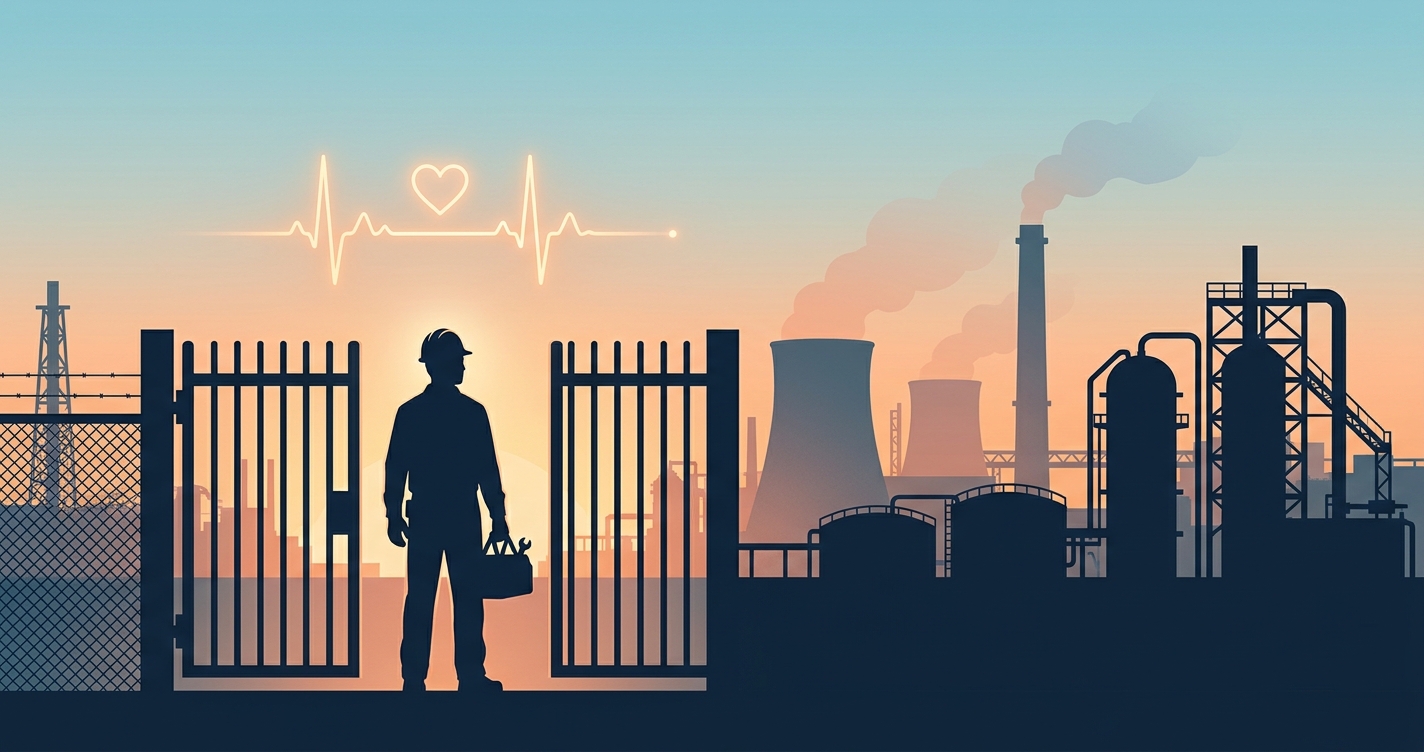
A serious incident on an industrial site almost never arrives without a warning. The warning is usually physiological, quiet, and already present when a worker walks through the gate. A foggy operator who slept four hours, a maintenance technician whose blood pressure is climbing toward a cardiac event, a haul truck driver whose reaction time has slowed by half. The question that keeps EHS directors awake is not whether these conditions exist on any given morning, but whether anything in the current process is built to catch them before the shift starts. Protecting safety-critical workforce health begins with one practical idea: a short, repeatable check at the start of every shift that screens for the conditions most likely to cause an accident that same day.
Fatigued workers are roughly three times more likely to be involved in a workplace accident than well-rested colleagues, and fatigue is estimated to contribute to as much as 13 percent of all workplace injuries, according to data compiled by the National Safety Council.
Why safety-critical workforce health is a same-day problem
Most safety programs are built around lagging indicators. Incidents are investigated after they happen, root causes are documented, and corrective actions are issued. This model has value, but it operates on a delay that does nothing for the worker who is impaired right now. Safety-critical workforce health flips the timeline. Instead of asking what went wrong last week, it asks a single question at the gate: is this person physiologically ready for the task in front of them today?
The conditions that matter most for same-day accident prevention share a useful trait. They show up in vital signs and behavior before they show up in an incident report. Acute fatigue, elevated cardiovascular strain, dehydration, and the after-effects of alcohol or certain medications all alter measurable signals such as heart rate, heart rate variability, breathing rate, and observable alertness. A check designed around these signals can flag a problem in under a minute, while the worker still has the option to step back, rest, hydrate, or be reassigned.
The scale of the underlying risk is well documented. The National Safety Council has reported that nearly 70 percent of workers in safety-critical industries report being tired at work. In construction, surveys have found that essentially every worker reports at least one risk factor for fatigue, with comparable figures of 97 percent in transportation and 98 percent in manufacturing. These are not edge cases. They describe the baseline condition of the workforce on a typical morning.
How pre-shift screening compares to traditional checks
A pre-shift health check is not the same as a pre-employment physical or a random compliance test. Each tool answers a different question on a different schedule. The table below frames where same-day screening fits.
| Approach | What it measures | Timing | Same-day accident relevance |
|---|---|---|---|
| Pre-employment physical | Baseline fitness and medical history | Once, at hire | Low. Conditions change daily after hire |
| Annual occupational health exam | Long-term health trends | Yearly | Low to moderate. Cannot catch acute states |
| Random or post-incident testing | Substance presence | Reactive or periodic | Moderate. Often confirms cause after the fact |
| Self-report check-in | Subjective readiness | Each shift | Moderate. Limited by underreporting |
| Pre-shift vitals and fatigue screening | Heart rate, HRV, breathing, alertness | Every shift, under a minute | High. Detects acute, same-day impairment |
The gap this table reveals is the heart of the matter. Annual exams and pre-employment physicals describe who a worker was at a single past moment. They cannot describe who shows up at 5 a.m. after a poor night of sleep or with rising cardiac strain. Pre-shift screening is the only layer designed to operate on the same timeline as the risk it is meant to prevent.
Practical advantages of a short pre-shift check include:
- It runs at the frequency of the hazard. Fatigue and cardiovascular strain change daily, so the screen runs daily.
- It reduces reliance on self-disclosure. Many workers under-report fatigue, and surveys show employers and employees disagree about how serious the problem is.
- It creates an objective, documented readiness signal that supports a fitness-for-duty decision.
- It gives the worker a private off-ramp before an impaired shift becomes an incident.
Industry applications
Heavy equipment and mining
Operators of haul trucks, cranes, and excavators face the steepest consequences of slowed reaction time. Research summarized by the National Safety Council indicates fatigue can slow reaction times by up to 50 percent, an effect comparable to alcohol impairment. A pre-shift screen that flags acute fatigue before a worker climbs into a 200-ton machine addresses the exact failure mode that drives the most severe mining and construction incidents.
Transportation and logistics
The Transportation and Warehousing sector recorded more than 1,000 fatalities in 2024, at a rate well above the national average. Long shifts and sleep loss were cited by 42 percent and 48 percent of transportation employees respectively as common fatigue causes. A same-day readiness check at dispatch gives operators a structured tool to support compliance with fatigue-related rules while catching the driver who is impaired today.
Manufacturing and process plants
Manufacturing involves rotating shifts, machine interaction, and confined spaces where a brief lapse can be catastrophic. With 98 percent of manufacturing workers reporting at least one fatigue risk factor, a pre-shift screen serves as a consistent gate that does not depend on a supervisor noticing something is off.
Current research and evidence
The evidence base draws from two converging lines of research. The first concerns fatigue. NIOSH established its Center for Work and Fatigue Research in 2020 to study health and safety risks tied to nonstandard schedules, reflecting growing recognition that fatigue is a measurable, manageable hazard rather than a personal failing. National Safety Council data attributing up to 13 percent of workplace injuries to fatigue gives the problem a quantifiable footprint.
The second line concerns cardiovascular events at work. A systematic review and meta-analysis on sudden cardiac death among workers, conducted across 2022 and 2023 and published through the U.S. National Library of Medicine, concluded that identifying workers at elevated risk through appropriate screening is central to prevention. The review also linked long working hours, shift work, and job strain to higher cardiovascular risk, the same conditions common in safety-critical roles. OSHA guidance on sudden cardiac arrest reinforces that early recognition and rapid response materially improve survival.
Taken together, the literature supports a clear logic. The conditions most likely to cause a same-day incident, acute fatigue and cardiovascular strain, are both detectable through vital signs and both responsive to early intervention. The remaining challenge is operational: deploying a check that is fast, non-invasive, and consistent enough to run before every shift without slowing the gate.
The future of safety-critical workforce health
The direction of the field is toward screening that is contactless, fast, and integrated with existing safety management systems. Camera-based and sensor-based methods that estimate heart rate, breathing, and signs of fatigue without physical contact reduce friction at the gate and remove the hygiene and throughput concerns of touch-based devices. The value compounds when individual screens roll up into trend data. A single elevated reading is a same-day flag. A pattern of elevated readings across a crew can reveal scheduling problems, heat exposure issues, or staffing gaps before they produce an incident.
Privacy and worker trust will shape adoption as much as the technology itself. The most durable programs treat the screen as a protective tool for the worker, not a surveillance mechanism, with clear data handling and a focus on readiness rather than diagnosis. As these practices mature, pre-shift screening is likely to move from a differentiator at leading sites to a baseline expectation across safety-critical industries.
Frequently asked questions
Can a one-minute health check really prevent an accident today?
It cannot guarantee prevention, but it directly targets the conditions most associated with same-day incidents. By flagging acute fatigue or cardiovascular strain before a worker starts a hazardous task, a pre-shift screen creates an opportunity to intervene while the problem is still reversible, which is exactly when prevention is possible.
How is this different from our annual occupational health exam?
An annual exam captures long-term health at a single point in time. It cannot detect the daily changes, such as poor sleep or rising blood pressure, that drive same-day risk. Pre-shift screening runs at the frequency of the hazard, every shift, to catch acute states an annual exam will always miss.
Will workers accept being screened before every shift?
Acceptance depends on framing and privacy. Programs that present screening as a fast, contactless tool that protects the worker, with transparent data practices and a readiness focus rather than diagnosis, tend to see strong buy-in. Many workers value an objective check that does not rely on them having to admit they are not at their best.
What conditions can pre-shift vitals screening actually flag?
Vitals-based screening focuses on signals tied to acute impairment: heart rate, heart rate variability, breathing rate, and observable alertness. These can indicate fatigue, cardiovascular strain, dehydration, and the lingering effects of alcohol or some medications, the categories most relevant to preventing a same-day incident.
Circadify is building toward this future of safety-critical workforce health with contactless pre-shift vitals and fatigue screening designed to fit the realities of a busy gate. If you are evaluating how same-day screening could strengthen your accident-prevention program, you can start a safety program inquiry at circadify.com/solutions/fraud-detection.