Wearable-Free Worker Health Monitoring: How Industrial Sites Use It
Industrial sites are adopting wearable-free worker health monitoring to proactively manage risks. Learn how technologies like computer vision and radar are used for pre-shift screening.
The operational complexity of industrial sites-from manufacturing and construction to energy and transportation-creates inherent risks. For decades, safety programs have focused on engineering controls and personal protective equipment (PPE). However, a significant variable has remained largely unaddressed: the fluctuating health and fitness-for-duty of the individual worker. The adoption of wearable-free worker health monitoring is a strategic shift, moving from a reactive safety posture to a proactive one by integrating physiological data into daily risk assessments. This approach addresses the persistent challenge of worker fatigue, a factor in a significant portion of workplace incidents.
"Fatigue costs employers an estimated $1,200 to $3,100 per employee annually in lost productivity. A typical employer with 1,000 employees can lose an average of $1 million per year due to fatigue-related issues."
- National Safety Council (NSC)
The shift to contactless health assessment
The core challenge in monitoring worker health in industrial environments has been the practicality of data collection. Wearable devices, while effective in some consumer contexts, have proven difficult to scale in these settings. Issues such as device charging, data syncing, employee privacy concerns, and the simple burden of wearing an additional piece of equipment have hindered widespread adoption. Wearable free worker health monitoring circumvents these challenges by using ambient sensors and advanced software to assess physiological indicators without requiring any physical contact with the worker.
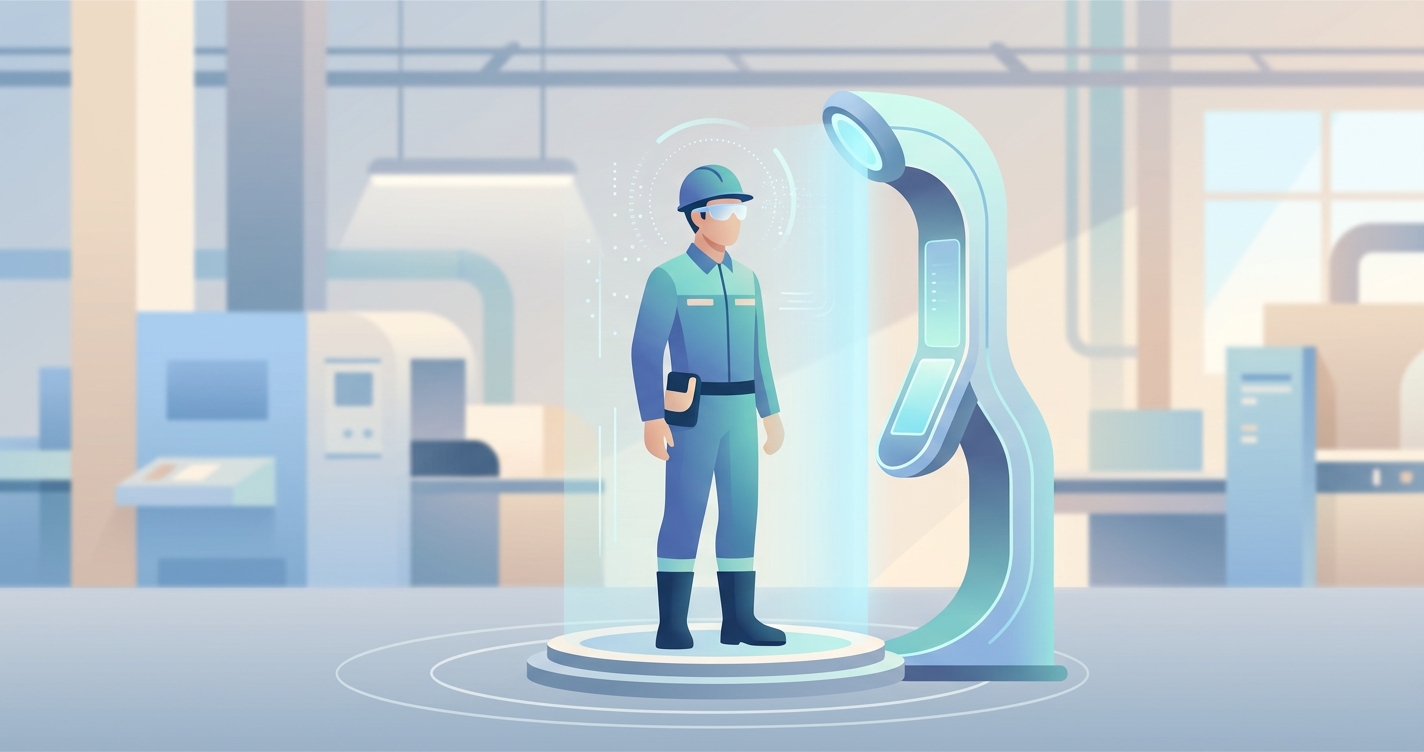
This new generation of technology uses computer vision, radar, and thermal imaging to conduct rapid, non-invasive health screenings. By integrating these systems at key chokepoints, such as site entrances or pre-shift briefing areas, organizations can gather baseline physiological data on every worker, every day. This allows for the identification of at-risk individuals before they enter a safety-critical environment. Research from institutions like the National Institutes of Health (NIH) has explored the underlying technologies, such as remote photoplethysmography (rPPG), which uses camera-based systems to measure heart rate and respiratory rate by detecting subtle changes in skin color.
| Technology | How It Works | Parameters Measured | Industrial Use Case |
|---|---|---|---|
| Computer Vision (rPPG) | Standard cameras analyze subtle, involuntary facial and skin color changes related to blood flow. | Heart Rate, Respiratory Rate, Heart Rate Variability (HRV), Blood Pressure (estimated). | Pre-shift fitness-for-duty screening at a site entry kiosk. |
| Radar | Low-power radio waves detect minute chest wall movements from breathing and cardiac activity. | Respiratory Rate, Heart Rate, Presence Detection. | Monitoring a vehicle operator for signs of microsleep or distress. |
| Thermal Imaging | Infrared cameras measure skin surface temperature and analyze patterns. | Core Body Temperature (estimated), Stress Indicators (facial temperature patterns). | Identifying potential signs of fever or heat stress in workers in high-temperature environments. |
| Voice Analysis | Microphones capture speech, and algorithms analyze tonal and acoustic features. | Fatigue, Stress, Cognitive Load. | Assessing operator alertness during communications checks. |
Industry Applications
The applications for wearable-free worker health monitoring span the entire project lifecycle, from pre-shift checks to real-time operational oversight.
Pre-shift fitness-for-duty screening
The most immediate application is the automation of pre-shift "fit for duty" assessments. Instead of relying on self-reporting, which is notoriously unreliable, a rapid, contactless scan can provide objective data on a worker's physiological state. A worker exhibiting an unusually high resting heart rate or signs of extreme fatigue can be flagged for a secondary check, such as a conversation with a supervisor or a more detailed health evaluation. This prevents a potentially impaired individual from operating heavy machinery or working at height.
Fatigue and distraction monitoring
For vehicle and equipment operators in sectors like transportation, mining, and logistics, in-cabin monitoring systems are becoming critical. Using a small camera and computer vision algorithms, these systems can track eye-gaze patterns, head position, and blink frequency to detect signs of drowsiness or distraction. If a driver's head begins to nod or their eyes close for a prolonged period, the system can issue an immediate auditory alert while also notifying a central dispatcher.
Environmental health and safety
Contactless systems can also be integrated with environmental sensors. For instance, in a hot environment, thermal imaging can be used To monitor workers for signs of heat stress. To correlate physiological data with ambient temperature and humidity readings. This provides EHS directors with a more complete picture of environmental risks and their impact on the workforce.
Current research and evidence
The technologies enabling wearable-free monitoring are advancing rapidly. A 2022 review published by the NIH detailed the multi-modal approach of combining different contactless sensors to improve accuracy and build a more comprehensive physiological profile. Researchers are actively working on refining algorithms to enhance the accuracy of blood pressure estimation from rPPG data and to better distinguish between different sources of physiological stress.
Leading research teams, such as those at institutions developing radar-based monitoring, have demonstrated the ability to capture ECG-level data through clothing, a significant advancement for real-time cardiac monitoring without attached electrodes. These studies underscore a clear trend: the fusion of multiple contactless data streams to create a more accurate and reliable assessment of a worker's health status.
The future of wearable-free worker health monitoring
The future of industrial safety will involve the deeper integration of these monitoring technologies into a site's digital ecosystem. Imagine a system where a worker's pre-shift vitals data is cross-referenced with their work schedule, the environmental conditions for the day, and their recent fatigue metrics. This holistic view enables a truly predictive safety model, where potential incidents are flagged and mitigated before they can occur.
As the technology becomes more widespread, the focus will shift from simple alerting to providing actionable insights. A report for an EHS director might not just flag a fatigued worker, but also show that fatigue incidents spike during the third consecutive night shift, providing data to support changes in scheduling policies. This transition from data collection to data-driven decision-making is where wearable-free worker health monitoring will provide the greatest value.
Frequently asked questions
Q: How accurate is wearable-free monitoring compared to traditional medical devices? A: While not a replacement for clinical-grade medical devices, the technology is designed for screening and trend analysis. Its accuracy is sufficient to detect significant deviations from a worker's baseline, indicating a potential fitness-for-duty concern. The primary goal is not diagnosis but early risk detection in an occupational setting.
Q: What about worker privacy? A: This is a critical consideration. Leading systems are designed with privacy in mind. Data is typically processed on-device or in a secure cloud environment, and access is restricted to authorized health and safety personnel. The data is used for safety purposes, not for surveillance, and clear policies and transparency with the workforce are essential for successful implementation.
Q: Does this technology require a lot of new infrastructure? A: Most systems are designed for easy retrofitting. A typical setup might involve a small kiosk with a tablet and camera at a site entrance or a small sensor unit mounted in the cab of a vehicle. They generally require a power source and a network connection (cellular or Wi-Fi) to transmit alert data.
The insights provided by wearable free worker health monitoring are transforming how industrial organizations approach safety. By moving beyond lagging indicators and embracing proactive, data-driven risk management, companies can create a safer and more productive work environment. Circadify is at the forefront of this space, developing solutions to address these critical needs. To learn more about building a modern safety program, connect with our team through our Safety program inquiry.