Worker Fatigue Monitoring: 7 Warning Signs on Site
A field guide to worker fatigue monitoring: seven observable and measurable red flags that tell safety managers when a crew member is unfit to operate.
Fatigue is the rare workplace hazard that hides inside the worker rather than the worksite, and that is exactly why it is so difficult to govern. A frayed sling or an exposed live conductor announces itself. A crew member who slept four hours, drove ninety minutes, and is now climbing into a haul truck looks identical to the colleague beside them who slept eight. Effective worker fatigue monitoring closes that visibility gap by giving supervisors a defined set of signals to watch for and, increasingly, to measure, before impairment becomes an incident. This report breaks down the seven warning signs that matter most on safety-critical sites and how leading occupational health teams are moving from gut feel to data.
"Up to 13 percent of workplace injuries can be attributed to fatigue, and workers sleeping fewer than six hours per night carry roughly 2.9 times the injury risk of well-rested peers." - National Safety Council, drawing on its Fatigue in Safety-Critical Industries research.
Why worker fatigue monitoring belongs at the top of the risk register
The economics alone justify attention. The National Safety Council estimates that fatigue costs U.S. employers approximately 136 billion dollars per year in health-related lost productivity, with each fatigued employee representing 1,200 to 3,100 dollars in annual losses. Survey data cited by NIOSH suggests roughly 97 percent of workers face at least one fatigue risk factor and more than 80 percent carry two or more. In transportation and other 24/7 sectors, the share of affected employers approaches the entire industry.
What makes worker fatigue monitoring distinct from generic wellness programs is the consequence profile. In mining, rail, energy, and heavy manufacturing, a single lapse in alertness can cascade into a fatality or a multi-million dollar equipment loss. The discipline is less about who feels tired and more about who is impaired enough to be a danger to themselves and the crew. That distinction is what separates the seven signs below into observable behaviors a supervisor can flag and measurable physiological markers a screening system can quantify.
The seven warning signs cluster into two families:
- Behavioral and cognitive signs that a trained supervisor can observe during a pre-shift exchange or toolbox talk.
- Physiological signs that are harder to fake and easier to standardize, which is why fatigue science has gravitated toward them.
Here is how the two approaches compare across the dimensions safety managers care about.
| Warning sign | How it appears on site | Detection method | Objectivity | Catches fatigue before the task starts? |
|---|---|---|---|---|
| Microsleeps and prolonged eye closure | Head nods, blank stares, eyes shut more than a second | Camera-based PERCLOS, observation | High when measured | Partly, often mid-task |
| Slowed reaction and decision lag | Delayed responses, missed calls on radio | Reaction-time test, observation | Medium | Yes, if tested pre-shift |
| Mood and irritability shifts | Short temper, withdrawal, flat affect | Supervisor observation | Low | Yes |
| Coordination and balance errors | Fumbling tools, unsteady footing | Observation | Low to medium | Yes |
| Elevated resting heart rate and altered HRV | Not visible to the eye | Contactless or wearable vitals | High | Yes |
| Abnormal breathing rate | Not visible to the eye | Contactless vitals | High | Yes |
| Self-reported sleep debt and yawning | Frequent yawning, admitted short sleep | Survey, observation | Low to medium | Yes |
The seven signs in detail
- Microsleeps and prolonged eye closure. PERCLOS, the percentage of time the eyes are closed, is the most validated single index of drowsiness in the research literature. It rises with sleep loss and during nighttime hours. The limitation is that microsleeps usually appear once a worker is already on task, making this a late indicator rather than a pre-shift filter.
- Slowed reaction and decision lag. Sleep restriction degrades reaction time before the worker subjectively feels impaired, which is why psychomotor vigilance tasks remain a benchmark in fatigue science.
- Mood and irritability shifts. Emotional volatility and social withdrawal are early cognitive symptoms, though they are subjective and easy to attribute to other causes.
- Coordination and balance errors. Fine motor slips and unsteady movement signal central nervous system fatigue, relevant for anyone working at height or around moving equipment.
- Elevated resting heart rate and altered heart rate variability. Autonomic markers shift measurably with sleep loss and accumulated strain, and unlike behavior they cannot be masked by willpower.
- Abnormal breathing rate. Respiratory rate is an underused but reliable physiological signal that screening systems can capture without contact.
- Self-reported sleep debt and yawning. Frequent yawning paired with admitted short sleep is the cheapest signal to collect, but it depends on honest disclosure in a culture where workers fear being sent home unpaid.
Industry applications for crew fatigue red flags
Mining and heavy construction
Long shifts, remote camps, and night rotations make these the canonical fatigue environments. Supervisors here increasingly pair observed crew fatigue red flags with pre-shift physiological checks because a single drowsy operator on a haul road or excavator endangers an entire pit.
Rail and commercial transport
Regulated hours-of-service rules set a floor, but compliance with a schedule does not guarantee a rested operator. Fatigue indicators on the job, especially reaction lag and microsleeps, are exactly what driver and operator monitoring systems were built to detect, and the same physiological logic now extends to gate-level screening before the locomotive or rig ever moves.
Energy, utilities, and high-hazard manufacturing
In nuclear, oil and gas, and chemical processing, the margin for error approaches zero. Here fatigue risk warning signs are integrated into formal fitness-for-duty programs, where objective vitals carry more procedural weight than a supervisor's subjective read.
Current research and evidence
The scientific case for moving toward measurable signals is strong. A 2023 analysis in Clocks and Sleep (Hammoud and colleagues) confirmed PERCLOS as a validated drowsiness measure that increases with sleep restriction, while also noting that PERCLOS alone is not sensitive enough to catch moderate drowsiness, arguing for fusion with other signals. Truck-driver simulator work published in PMC evaluating eye-closure-associated indicators reached a similar conclusion, that combining eye metrics with additional channels improves reliability.
Physiological fusion is the consistent theme. Reviews from 2022 onward report that integrating PERCLOS with heart rate variability, blink dynamics, and respiratory signals produces more robust detection than any single marker. On the policy side, NIOSH established its Center for Work and Fatigue Research and published a dedicated special issue in the American Journal of Industrial Medicine in November 2022, signaling that fatigue has moved from a peripheral wellness topic to a core occupational hazard with its own research infrastructure.
The practical takeaway for safety leaders is that behavioral observation remains necessary but is no longer sufficient. The most defensible programs layer measurable autonomic signals, heart rate, heart rate variability, and breathing rate, on top of trained supervisor judgment, so a fatigue determination rests on data rather than a single person's impression.
The future of worker fatigue monitoring
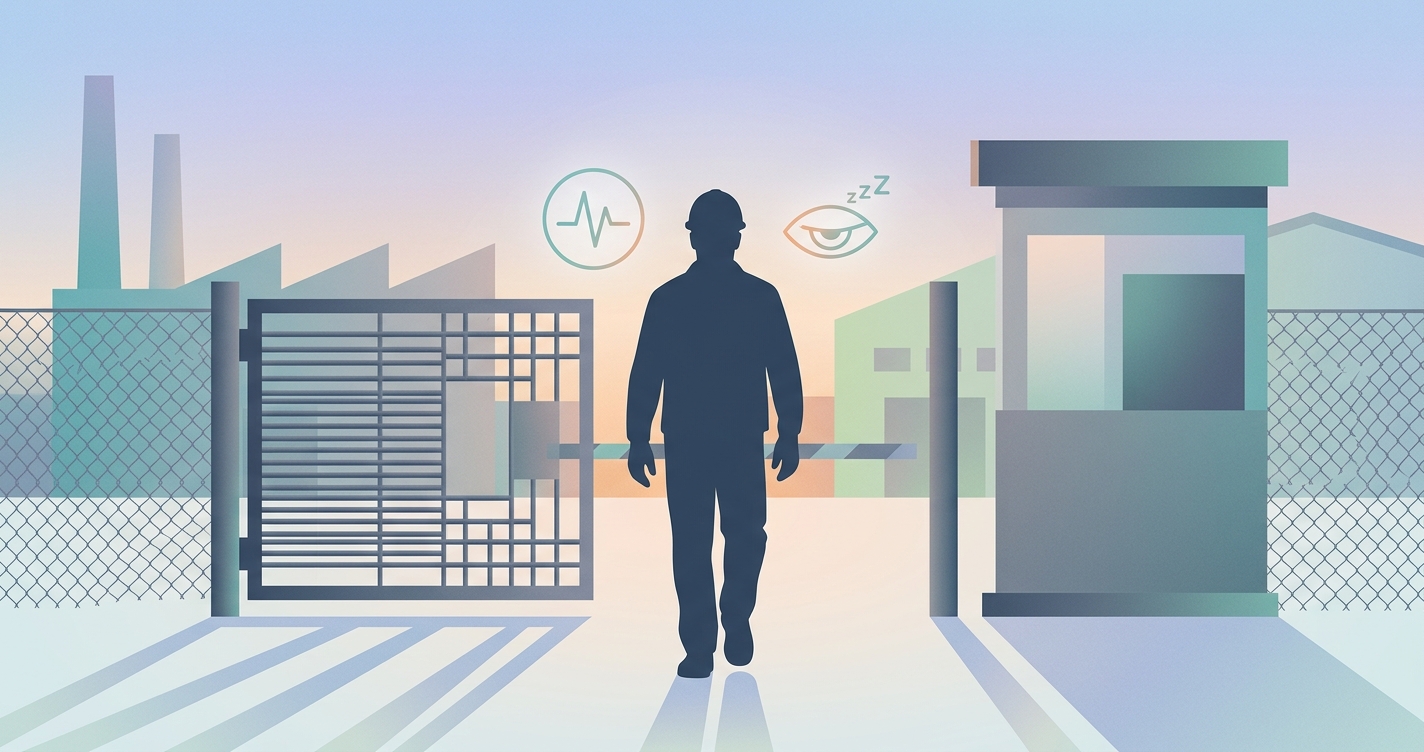
Three shifts are reshaping the field. First, detection is moving from mid-task to pre-task. Camera-based microsleep systems catch impairment after a worker is already operating; contactless pre-shift vitals screening aims to flag risk at the gate, before the equipment is keyed on. Second, measurement is moving from contact to contactless. Programs that once relied on wearables now explore camera-based capture of pulse and respiration to reduce friction and improve compliance, since a screen workers walk past is easier to sustain than hardware they must wear. Third, fatigue data is being integrated into broader safety management systems, so a fatigue flag triggers a documented workflow rather than an informal conversation.
Privacy and worker trust will determine adoption speed. Screening that is fast, contactless, and clearly framed around safety rather than surveillance is far likelier to win crew acceptance, which is the real bottleneck for any fatigue program.
Frequently asked questions
What is the single most reliable sign of worker fatigue? No single sign is definitive. PERCLOS, the percentage of eye closure, is the most validated individual marker in research, but studies consistently show that combining it with physiological signals such as heart rate variability and breathing rate gives the most reliable read of impairment.
Can a supervisor detect fatigue just by observation? Trained supervisors can catch behavioral signs like yawning, irritability, and coordination errors, and observation remains valuable. The weakness is subjectivity. Workers often mask tiredness, and impairment degrades reaction time before it becomes visible, which is why objective physiological screening is increasingly added.
How does fatigue actually raise injury risk? Sleep loss slows reaction time, impairs judgment, and produces brief microsleeps. National Safety Council research links fatigue to up to 13 percent of workplace injuries, with sub-six-hour sleepers carrying roughly 2.9 times the injury risk.
Is pre-shift fatigue screening better than mid-task monitoring? They serve different purposes. Mid-task camera systems catch drowsiness once work is underway, while pre-shift screening aims to identify at-risk workers before they begin a hazardous task, which is generally the stronger prevention point.
Circadify is building toward this gate-level future, developing contactless pre-shift vitals screening designed to surface fatigue risk warning signs before a worker takes the controls. Safety leaders evaluating how measurable fatigue indicators could fit their fitness-for-duty programs can start a safety program inquiry to explore contactless screening adoption.