Why do I feel completely drained by 2 PM, and how can my job help?
The 2 PM energy crash is a measurable circadian event. How worker fatigue monitoring helps occupational health teams identify and address mid-shift drain.
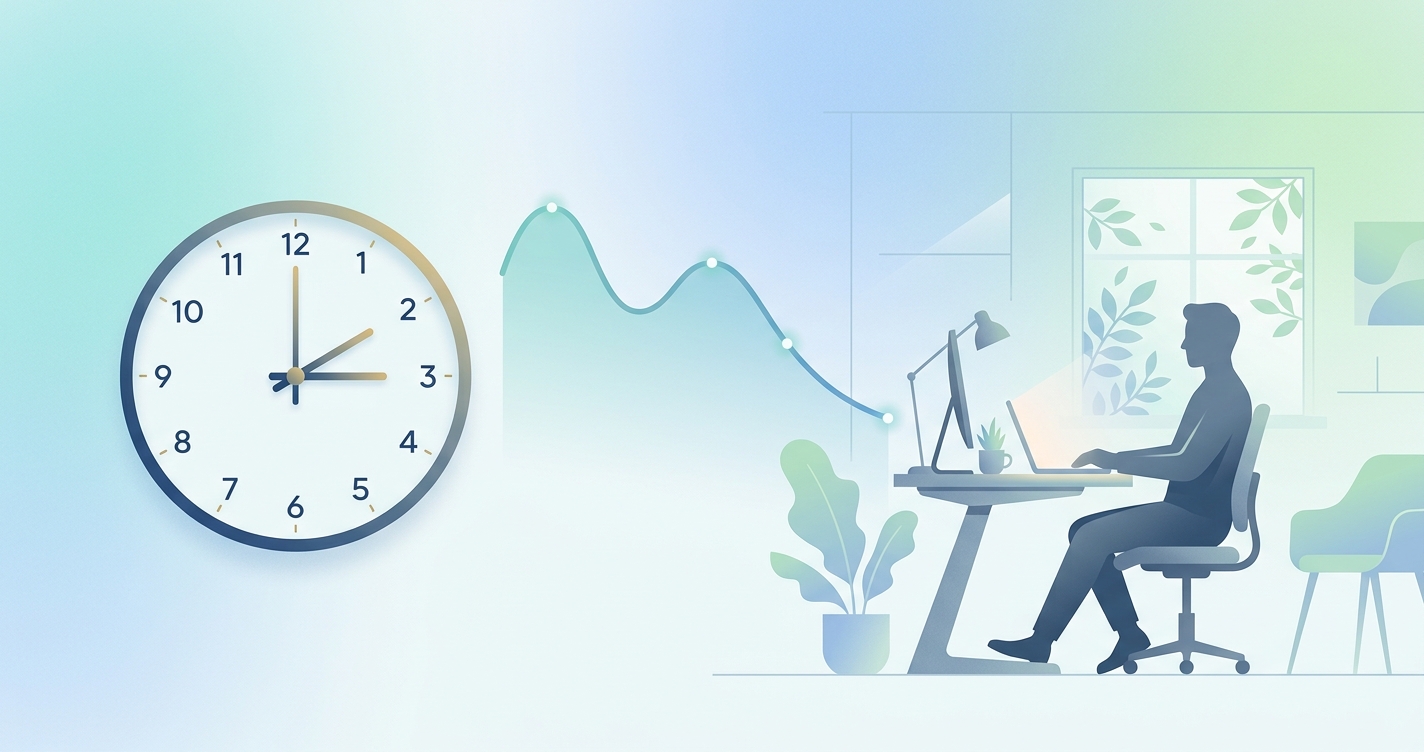
If you operate machinery, drive a route, or run a process line, the early afternoon often arrives with a familiar weight. Concentration thins, reaction time slows, and the clock seems to stall somewhere around 2 PM. This is not a character flaw or a sign you need more coffee. It is a predictable feature of human physiology, and it is one of the most documented patterns in occupational science. For the EHS directors and occupational health providers reading this, that predictability is the point: a hazard that follows a clock can be measured, and what gets measured can be managed. This is where worker fatigue monitoring moves from an abstract wellness idea to a concrete safety control.
The National Safety Council estimates that 13 percent of workplace injuries can be attributed to fatigue, while 97 percent of workers carry at least one fatigue risk factor and more than 80 percent carry two or more.
What worker fatigue monitoring reveals about the 2 PM crash
The mid-afternoon drain has a name in chronobiology: the post-lunch dip. It is a recurring decline in alertness, energy, and cognitive performance that typically lands between roughly 1 PM and 3 PM. Crucially, researchers have shown the dip occurs even when no lunch is eaten. It is driven primarily by the body's internal clock, including a small drop in core body temperature and a transient rise in sleep pressure, and it is amplified by short overnight sleep, heavy high-carbohydrate meals, and night or rotating shift schedules.
This matters for safety-critical work because the dip lines up with hard physical evidence of harm. A widely cited Spanish analysis of workplace accidents found that incidents occurring after lunch tend to be more serious, and in some datasets more frequently fatal, than those earlier in the day. The drop in vigilance is not just a comfort problem. It is a risk window.
Worker fatigue monitoring is the practice of detecting that risk window before it produces an incident. Rather than relying on a supervisor's guess or a worker's self-report, monitoring uses physiological signals and behavioral data to flag when someone is sliding into impairment. The signals most associated with fatigue are familiar to any occupational health clinician: changes in heart rate and heart rate variability, altered respiratory patterns, slowed reaction time, and shifts in the autonomic markers that track arousal.
The strategic shift here is from lagging indicators to leading ones. For decades, safety management investigated incidents after they happened. Fatigue monitoring aims to catch the physiological precursor while there is still time to intervene, whether that means a rotation, a break, a task swap, or a conversation.
Comparing approaches to fatigue detection
Occupational health teams have several options for identifying mid-shift fatigue, and each carries different tradeoffs in accuracy, intrusiveness, and practicality across a shift.
| Approach | What it measures | Strengths | Limitations |
|---|---|---|---|
| Self-report surveys | Subjective sleepiness and perceived alertness | Cheap, easy to deploy, captures worker context | Workers may underreport to avoid being sent home; recall bias |
| Supervisor observation | Visible signs such as yawning, errors, slowed movement | No equipment needed; human judgment | Inconsistent, only catches late-stage fatigue, hard to scale |
| Wearable sensors | Heart rate, HRV, movement, sometimes skin temperature | Continuous data through the shift | Compliance and comfort issues; battery and hygiene logistics |
| Pre-shift vitals screening | Baseline cardiovascular and autonomic state before work | Objective gate before exposure begins | Single point in time; does not track mid-shift drift on its own |
| Contactless camera-based scans | Pulse, respiration, and related vitals from a brief facial scan | Fast, hygienic, no device on the body | Emerging method; depends on lighting and protocol consistency |
No single tool is complete. The most defensible programs layer methods, using an objective pre-shift baseline to establish fitness for duty and then revisiting workers at known risk points, such as the early afternoon dip or the small hours of a night shift.
A practical fatigue monitoring program tends to share a few features:
- A consistent baseline captured at the same point in each shift, so deviations are visible.
- Thresholds set with occupational health input rather than arbitrary cutoffs.
- A clear escalation pathway so a flag triggers an action, not just a data point.
- Privacy safeguards that keep physiological data confidential and use-limited.
- Worker communication that frames monitoring as protection, not surveillance.
Industry applications of fatigue monitoring
Transportation and logistics
Drivers and rail crews face fatigue rules precisely because the post-lunch and overnight windows are so dangerous. Monitoring helps operators document that a worker was screened at the start of a duty period and supports objective decisions when a mid-route check raises concern.
Mining and heavy industry
Long shifts, remote sites, and demanding physical work compound circadian fatigue. A 2 PM dip in a worker controlling a haul truck or a press carries outsized consequences. Physiological screening gives safety managers an early signal that is harder to mask than a verbal check-in.
Healthcare and emergency services
Shift-working clinicians experience some of the most severe circadian misalignment. Research on shift-working nurses points to a pathway running from disrupted sleep through fatigue to compromised safety behavior, making objective monitoring relevant well beyond industrial floors.
Manufacturing and processing
Repetitive tasks during the afternoon dip invite the kind of attention lapses that produce both quality defects and injuries. Monitoring at the gate and at mid-shift creates a record that supports staffing and rotation decisions.
Current research and evidence
The evidence base for mid-shift fatigue is strong and growing. The post-lunch dip has been characterized across laboratory and field studies as a genuine circadian phenomenon rather than a simple consequence of eating. Investigations into driving fatigue among well-rested subjects have found the dip degrades performance even in people who slept adequately, which underlines why scheduling and monitoring matter alongside sleep hygiene.
On the cost side, the National Safety Council estimates that fatigue costs employers roughly 136 billion dollars a year in health-related lost productivity, with per-employee losses ranging between about 1,200 and 3,100 dollars annually. The NSC also reports that more than 37 percent of employees are sleep-deprived, with night, long, rotating, and irregular shift workers most exposed. A typical employer with 1,000 workers can lose more than 1 million dollars a year to fatigue once absenteeism and presenteeism are combined.
On the intervention side, a 2024 study published through Oxford Academic found that circadian-informed lighting improved vigilance, sleep, and subjective sleepiness during simulated night-shift work. That line of research suggests fatigue is Detectable. Modifiable when organizations act on what they measure. The combination of reliable detection and workable countermeasures is what makes monitoring an operational tool rather than a diagnosis.
The future of worker fatigue monitoring
Three trends are shaping where this field is heading. First, measurement is becoming less intrusive. Contactless approaches that read vitals from a short facial scan reduce the compliance and hygiene friction that has limited body-worn devices, which makes frequent checks more realistic across a shift. Second, fatigue data is moving into safety management systems rather than living in isolated spreadsheets, so a flag can connect to staffing, rotation, and incident records. Third, expectations around privacy are maturing. Programs that succeed will treat physiological data as sensitive, limit its use to safety purposes, and give workers transparency about what is collected and why.
The destination is a model where the 2 PM slump is treated as a managed event. Instead of hoping individuals push through, occupational health teams will anticipate the dip, screen at the right moments, and deploy countermeasures, from rest breaks to lighting to task rotation, before impairment becomes incident.
Frequently asked questions
Why do I feel drained specifically around 2 PM?
The early afternoon decline is the post-lunch dip, a circadian pattern marked by a small drop in core body temperature and a rise in sleep pressure. It happens even without eating, and it is worsened by short sleep, heavy meals, and shift schedules that fight the body's clock.
Is worker fatigue monitoring the same as surveillance?
No. Effective programs measure physiological signals tied to safety, keep that data confidential and use-limited, and connect flags to supportive actions such as breaks or rotations. The goal is to protect workers from a known hazard, not to track behavior.
Can fatigue really be detected before an accident?
Fatigue produces measurable changes in heart rate, heart rate variability, respiration, and reaction time before visible errors appear. Monitoring those leading indicators gives teams a window to intervene, which is the core advantage over investigating incidents after they occur.
What can my employer actually do once fatigue is detected?
Documented options include scheduled rest breaks, task rotation away from high-risk machinery, adjusted lighting, and conversations about sleep and scheduling. Detection only adds value when it is paired with a clear, agreed escalation pathway.
Circadify is working on this space through contactless pre-shift vitals screening and fatigue detection built for safety-critical workforces, helping occupational health teams turn the predictable 2 PM dip into a managed risk rather than a hidden one. To explore how this fits an existing safety program, start a safety program inquiry.