Is my body ready for another demanding 10-hour shift without feeling burnt out?
How worker fatigue monitoring helps occupational health teams assess shift readiness, prevent burnout, and protect sustained performance in safety-critical roles.
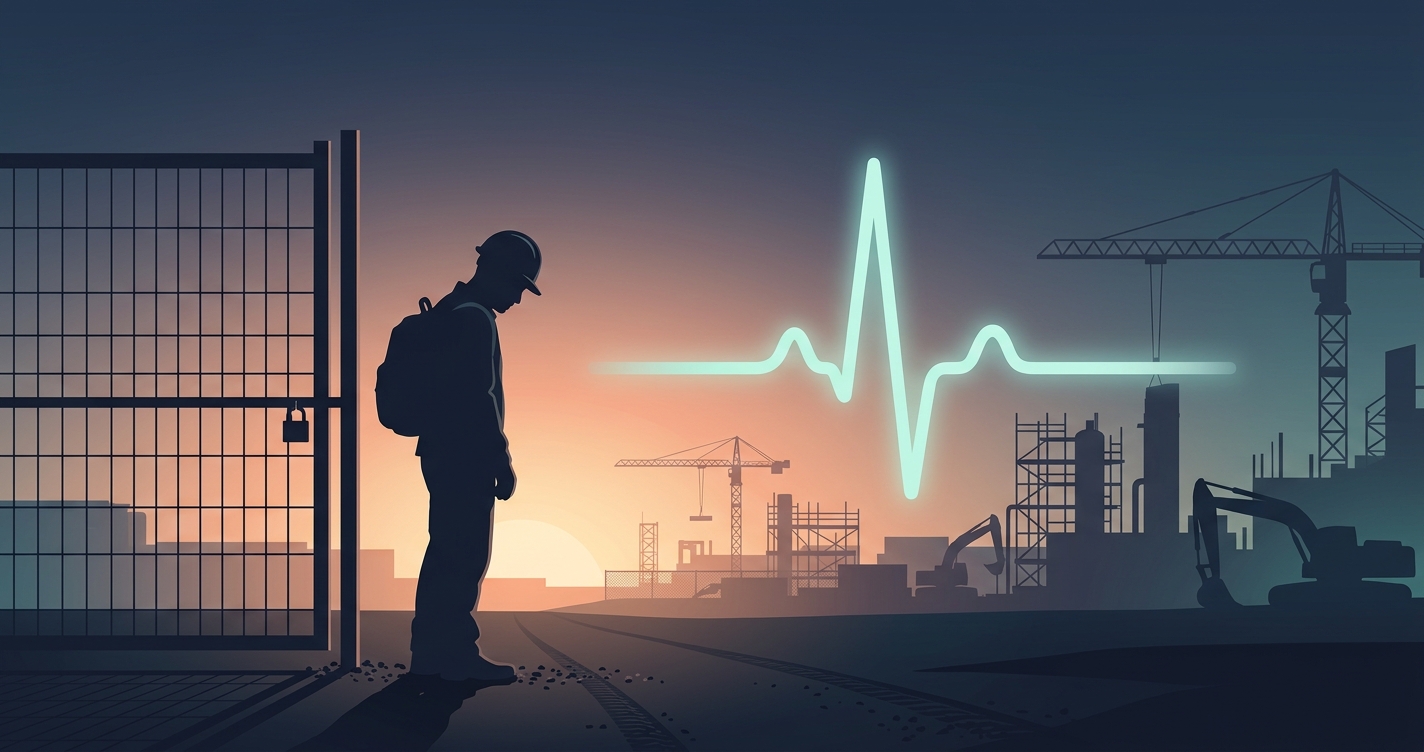
Before the gate opens on a long shift, most workers run a quiet self-assessment. They ask whether they slept enough, whether the last rotation drained them, and whether they can hold focus for ten more hours of demanding work. That internal question, repeated millions of times a day across mines, plants, rail yards, and warehouses, is one of the least reliable instruments in occupational safety. Self-reported readiness is shaped by financial pressure, peer expectation, and the simple human tendency to underestimate one's own exhaustion. This gap between how ready a body feels and how ready it actually is sits at the center of modern worker fatigue monitoring, and it is now a measurable problem rather than a matter of guesswork.
Fatigued workers cost employers an estimated 1,200 USD to 3,100 USD per employee each year in lost productivity, and the National Safety Council reports that 13 percent of workplace injuries can be attributed to fatigue.
What worker fatigue monitoring actually measures
Worker fatigue monitoring is the practice of using objective physiological and behavioral signals to estimate whether a person can sustain safe performance through a defined work period. It moves the readiness question out of the worker's head and into data that an occupational health team can review. The most studied of these signals is heart rate variability (HRV), the small beat-to-beat fluctuation in cardiac rhythm that reflects autonomic nervous system balance. When the body is recovered, the parasympathetic system keeps HRV relatively high. When sleep debt, accumulated workload, or early burnout take hold, HRV tends to fall.
A 2023 systematic review summarized by researchers across multiple medical populations found that decreased HRV is consistently associated with increased fatigue, even before performance visibly declines. That early-warning property is what makes the metric useful at the start of a shift rather than after an incident. Importantly, fatigue is not a single state. Occupational health providers generally distinguish three layers, each of which a monitoring program should treat differently:
- Acute fatigue: short-term tiredness from one poor night or a single hard shift, usually resolved by normal rest.
- Cumulative fatigue: a rolling deficit built across consecutive demanding shifts, the most common driver of mid-rotation safety events.
- Chronic fatigue and burnout: a sustained physiological and psychological depletion that does not reverse with a single rest day and predicts attrition.
The value of monitoring is not catching someone in a single bad moment. It is detecting the slope, the multi-day drift toward exhaustion that a worker often cannot feel until it is too late.
Comparing readiness assessment methods
Occupational health teams have several options for answering the readiness question. They differ sharply in objectivity, intrusiveness, and how early they detect trouble.
| Method | What it measures | Objectivity | Burden on worker | Early-warning value |
|---|---|---|---|---|
| Self-report survey | Perceived tiredness | Low | Low | Low |
| Reaction-time test (PVT) | Cognitive slowing | Medium | Medium | Medium |
| Wearable sleep tracking | Prior-night sleep | Medium | Medium (continuous wear) | Medium |
| HRV and vitals screening | Autonomic recovery state | High | Low (brief check) | High |
| Post-incident investigation | Outcome after the fact | High | None | None (lagging) |
The pattern is consistent across the table. The methods that feel easiest to deploy, surveys and after-the-fact review, are also the weakest at preventing the next event. Physiological screening that captures autonomic state offers the strongest combination of objectivity and early warning while keeping the daily burden on the worker low.
Why the 10-hour shift is a specific risk window
Extended shifts compress recovery time and stretch the period during which alertness must hold. Research on time-on-task effects shows that HRV shifts measurably as mental fatigue accumulates across a work period, a finding repeated in a systematic review of HRV and mental fatigue. For a 10-hour or 12-hour shift, the worker who started slightly under-recovered does not simply feel tired sooner. Their physiological margin for handling a heat spike, a complex task, or an unexpected hazard is already thinner at the gate.
This is why pre-shift screening matters more in extended-hour operations. A worker who would be perfectly safe across an 8-hour day may be operating without reserve by hour nine of a longer one. Worker fatigue monitoring at the start of the shift gives the safety team a chance to redeploy, pair, or rest that worker before the thin margin becomes an incident.
Industry Applications
Heavy industry and mining
In mining and heavy manufacturing, cumulative fatigue across compressed rosters is a documented hazard. Pre-shift fatigue screening lets supervisors identify the small number of workers on a given day whose recovery state has drifted, and adjust task assignment without singling out individuals through subjective judgment.
Transportation and rail
Operators in transportation already work under hours-of-service rules, but those rules govern time, not physiology. Two drivers with identical legal rest can arrive in very different recovery states. A 2024 fatigue biomarker trial conducted by Monash University with emergency service and transport workers examined how physiological signals can supplement scheduling rules, pointing toward readiness assessment that reflects the body rather than the clock.
Healthcare and emergency response
Burnout is acute in healthcare. Research published on medRxiv proposed an HRV-based predictive model of burnout in healthcare workers that integrates psychosocial and occupational factors. For occupational health providers in hospital systems, this suggests a path to flag depletion before a clinician reaches the point of error or resignation.
Current research and evidence
The evidence base for physiological fatigue monitoring has matured quickly. A 2024 review framing HRV as a dual-use digital biomarker described its integration across clinical, AI, and operational settings, noting that HRV can distinguish individuals able to sustain operational effectiveness from those approaching exhaustion. Separate work indexed in PubMed Central introduced fatigue assessment methods combining HRV with pulse arrival time to enable personalized feedback from wearable sensors, improving on single-metric approaches.
Three themes recur across this literature:
- No single number defines fatigue; combining HRV with sleep and workload data produces more reliable readiness estimates than any metric alone.
- Personal baselines matter more than population norms, because a healthy resting HRV varies widely between individuals.
- Machine learning models improve detection but require clean, repeated measurements to establish the individual baseline they depend on.
The Occupational Safety and Health Administration has also published guidance recognizing fatigue as a workplace hazard requiring active management, reflecting a regulatory shift from treating fatigue as a personal failing to treating it as a controllable risk.
The future of worker fatigue monitoring
The direction of travel is toward fast, contactless, baseline-aware screening that fits into the existing flow of a shift start. Camera-based vitals estimation now allows heart rate and related signals to be captured in seconds without a worn device, which removes the compliance problem of wearables that workers forget or resist. The next stage is integration: feeding readiness scores into the safety management systems that already govern task assignment, so a flagged worker triggers a documented, consistent response rather than an ad hoc supervisor decision.
Privacy and trust will shape adoption as much as accuracy. Programs that frame monitoring as protection rather than surveillance, that keep individual data confidential, and that give workers their own readiness feedback are the ones likely to win sustained participation. The goal is not to catch tired workers. It is to make the quiet pre-shift self-assessment something the body can answer honestly, before another demanding shift quietly tips into burnout.
Frequently asked questions
Can technology really tell if I am too fatigued for a 10-hour shift?
It can estimate readiness, not deliver a verdict. By comparing your current physiological signals such as heart rate variability against your personal baseline, monitoring tools flag when your recovery state has drifted below normal. That flag prompts a human review and a conversation, which is far more reliable than self-report alone.
Is worker fatigue monitoring the same as tracking my sleep?
No. Sleep tracking measures one input to fatigue, the prior night's rest. Fatigue monitoring measures the body's actual recovery state, which reflects sleep but also cumulative workload, stress, illness, and individual resilience. Two people with identical sleep can have very different readiness.
Does fatigue monitoring invade worker privacy?
It depends entirely on program design. Contactless pre-shift screening can produce a simple readiness indicator without storing continuous personal health records. Strong programs limit data to what is needed for the safety decision, keep results confidential, and share individual feedback with the worker.
How early can fatigue be detected before it causes a problem?
Research shows physiological markers like reduced HRV often shift before performance visibly declines, which is what makes pre-shift screening useful. Detecting a multi-day downward trend lets a safety team intervene during the cumulative-fatigue stage, well before chronic burnout or an incident.
Circadify is building toward this space with contactless pre-shift vitals screening designed to give occupational health teams an objective read on readiness without slowing down the start of a shift. Safety leaders evaluating how to add fatigue detection to an existing program can start a safety program inquiry to explore what fits their workforce.