Worker Fatigue Monitoring vs Random Testing: Which Works
A research comparison of continuous worker fatigue monitoring against random spot-testing for catching impaired workers before incidents on safety-critical sites.
Every safety-critical operation runs on a quiet assumption: the person stepping onto the haul road, the rig deck, or the press line is fit to be there. For decades, the dominant tool for testing that assumption has been random spot-testing for drugs and alcohol. Yet the impairment that actually drives most modern incidents is rarely chemical. It is exhaustion. As safety teams reconsider their screening stack, the comparison between worker fatigue monitoring and random testing has become one of the more consequential procurement debates in occupational health, because the two approaches catch fundamentally different problems at fundamentally different moments.
"Approximately 97% of workers globally face at least one workplace risk factor for fatigue, with over 80% encountering two or more.", Bodytrak, Global Worker Fatigue Statistics, 2024
That figure reframes the conversation. Substance impairment is a real and persistent hazard, but it is a minority condition in the workforce. Fatigue is closer to universal. Any screening strategy that measures only one and ignores the other is, by definition, leaving the larger exposure unmanaged.
Worker fatigue monitoring vs random testing: two different theories of risk
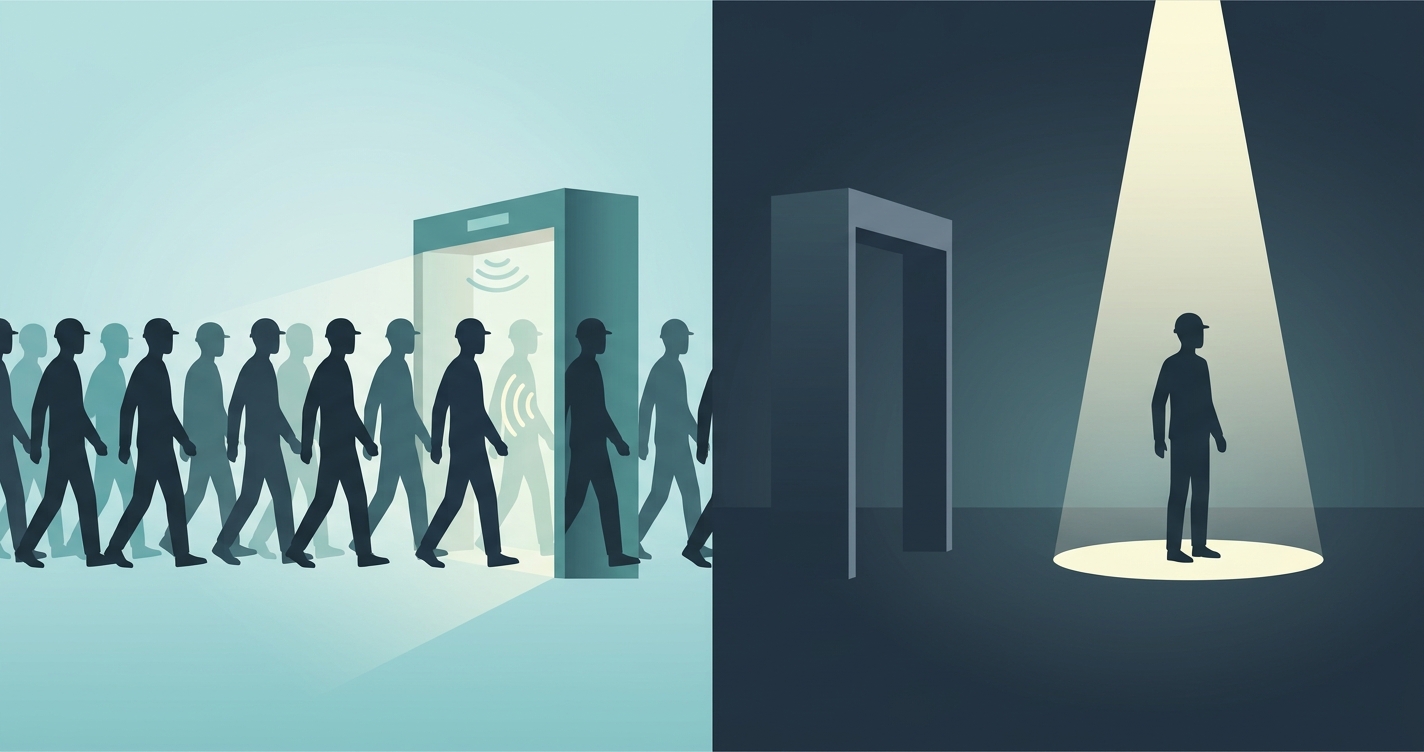
The core distinction is not technological. It is philosophical. Random testing is a deterrence-and-detection model. It assumes a small subset of workers will arrive impaired by a substance, and that the unpredictable threat of being selected discourages that behavior while catching some offenders after the fact. Worker fatigue monitoring is a prevention-and-readiness model. It assumes that physiological state varies day to day for everyone, and that measuring readiness before the shift can flag a worker who is dangerous today even though they did nothing wrong.
This is the heart of the fatigue monitoring vs drug testing question. A drug panel answers "did this person consume a prohibited substance in a detectable window?" A fatigue screen answers "is this person's body in a state to operate safely right now?" Those are not competing answers to the same question. They are answers to two different questions, and only one of them addresses the cause of most fatigue-related events.
Consider the timing problem. Random testing is, by design, infrequent and retrospective. A urine panel may detect cannabis metabolites for days or weeks after use, long after any impairment has passed, while missing the worker who is dangerously sleep-deprived on the morning they are tested. The 2024 Quest Diagnostics Drug Testing Index reported an overall workforce positivity rate of 4.4%, with post-accident marijuana positivity at 7.3%. Those numbers confirm that substance impairment contributes to incidents, but they also show it is present in a small fraction of the workforce. The remaining exposure sits elsewhere.
| Dimension | Worker Fatigue Monitoring | Random Drug and Alcohol Testing |
|---|---|---|
| Primary question answered | Is the worker physiologically ready today? | Did the worker use a prohibited substance? |
| Timing | Continuous or pre-shift, before exposure | Periodic, often retrospective |
| Coverage | Every worker, every relevant shift | A randomized subset over time |
| Hazard addressed | Sleep debt, circadian disruption, acute strain | Drug and alcohol impairment |
| Model | Proactive and preventive | Reactive and deterrent |
| Catches incident before it happens | Often, by flagging readiness pre-shift | Rarely, results lag the event |
| False-negative risk | Misses chemical impairment | Misses fatigue, illness, acute stress |
| Worker experience | Routine, low-friction, applies to all | Selective, can feel punitive |
The table makes the strategic point clear: these tools have almost no overlap in what they detect. A mature program does not choose fatigue monitoring instead of substance testing for cause or post-incident. It recognizes that random testing was never designed to catch tiredness, and that fatigue is the larger uncontrolled variable.
Key structural differences worth weighing during program design:
- Random testing coverage is probabilistic. In any given month most workers are never screened, so an impaired worker can pass undetected simply by not being selected.
- Fatigue monitoring coverage is comprehensive. A pre-shift screen applies the same readiness check to the whole crew on the days that matter.
- Random testing produces a binary pass or fail tied to legal thresholds, which is useful for policy enforcement but blunt for risk prediction.
- Fatigue monitoring produces a graded readiness signal that supports intervention short of removal, such as reassignment, a rest break, or closer supervision.
Industry applications of proactive vs reactive safety screening
The proactive vs reactive safety screening divide plays out differently across sectors, and the choice of approach tends to follow where the dominant hazard actually lives.
Mining and heavy construction
Long shifts, night rotations, and remote camps make sleep debt the defining exposure on these sites. Random substance testing remains a compliance fixture, but it does nothing for a haul truck operator entering hour eleven of a night shift. Continuous screening vs random checks here is not a close call: the incident data points overwhelmingly toward fatigue and circadian disruption as the controllable variable.
Transportation and rail
Hours-of-service rules already acknowledge that fatigue, not chemistry, is the primary driver of operator error in transport. Federal fatigue rules in rail and trucking push operators toward continuous fatigue risk management rather than relying on periodic chemical panels alone. Pre-shift readiness screening fits naturally into a model where the regulator has effectively conceded that time-on-task is the hazard.
Manufacturing and energy
Rotating shifts and 24/7 operation create chronic circadian strain across the entire workforce. Because the exposure is population-wide rather than concentrated in a few individuals, a tool that screens everyone before the shift covers more risk per dollar than one that samples a few workers per cycle.
Current research and evidence
The evidence base is where the comparison gets uncomfortable for the status quo. A Cochrane systematic review by Els and colleagues, "Random drug and alcohol testing for preventing injury in workers," found insufficient high-quality evidence that random testing alone reduces occupational injuries, noting the field relies heavily on interrupted time-series data of limited strength. Deterrence may exist, but the direct link from random testing to fewer incidents is not well established in the literature.
Fatigue risk management has a more nuanced but arguably more promising evidence picture. A 2022 review of Fatigue Risk Management Systems found that while few studies evaluate FRMS as a complete system, individual components, including biomathematical models, self-report measures, and performance monitoring, have produced measurable improvements in safety and fatigue metrics. The authors concluded that the strength of the components implies the integrated system is likely to deliver positive safety outcomes, with success depending on organizational commitment and a supportive culture rather than technology alone.
Separately, research summarized by NIOSH and the U.S. Centers for Disease Control and Prevention on working hours and fatigue has repeatedly tied extended and irregular shifts to elevated injury risk. Combined with the scale captured in the Bodytrak 2024 statistics and the roughly 4,337 preventable work deaths the National Safety Council recorded for 2024, the picture is consistent: fatigue is a large, measurable, and addressable contributor that random chemical testing structurally cannot see.
The future of worker fatigue monitoring
The trajectory points toward layered screening rather than a single tool. Substance testing will persist where law and policy require it, particularly for-cause and post-incident. But the growth is in pre-shift physiological screening that treats readiness as a daily variable for the whole crew, not a rare exception flagged by lottery.
Three shifts are likely to define the next several years:
- Movement from periodic sampling toward continuous and pre-shift readiness checks as the default front line.
- Contactless and low-friction measurement that removes the dignity and bottleneck problems of invasive testing, making whole-crew screening operationally realistic.
- Integration of readiness signals into fatigue risk scorecards, so that a single low reading triggers graded intervention rather than only a pass-or-fail decision.
The organizations getting ahead are not framing this as fatigue monitoring versus drug testing. They are asking which hazard their current stack leaves uncontrolled, and the honest answer is almost always fatigue.
Frequently asked questions
Does fatigue monitoring replace drug and alcohol testing? No. They address different hazards. Substance testing detects chemical impairment and is often legally mandated, while fatigue monitoring detects physiological readiness. A complete program uses both, with fatigue screening filling the much larger gap that random testing was never built to cover.
Why is random testing considered reactive? Random testing is infrequent, applies to a subset of workers, and frequently returns results after any impairment window has passed. It deters and documents more than it prevents. Fatigue monitoring is proactive because it measures readiness before the worker is exposed to the hazard.
Is there research showing random testing reduces injuries? A Cochrane review by Els and colleagues found insufficient strong evidence that random testing alone reduces workplace injuries. Deterrence likely exists, but the direct injury-reduction link is not well established, which is part of why safety teams are reassessing where to invest.
Which industries benefit most from continuous screening over random checks? Operations with long shifts, night rotations, and 24/7 schedules, such as mining, construction, rail, transportation, manufacturing, and energy, where fatigue is a population-wide exposure rather than a rare individual condition.
For safety leaders weighing continuous screening vs random checks, the practical next step is a controlled trial on a single crew. Circadify is addressing this space with contactless, pre-shift vitals and fatigue screening built for safety-critical workforces, and EHS teams can scope a daily screening pilot through a safety program inquiry to measure readiness coverage against their existing testing program.