How to Spot Worker Fatigue Without a Blood Test
A research look at worker fatigue monitoring using vital-sign patterns instead of blood or urine tests, and what non-invasive screening means for safety teams.
Fatigue is the rare workplace hazard that leaves no residue. A worker who has slept four hours carries no chemical signature that a drug panel can flag, and a urine sample reveals nothing about how many micro-sleeps that person will experience on a night shift. For safety leaders, this is the central problem: the most common impairment on safety-critical sites is also the one that biochemical testing cannot see. The good news is that fatigue does change the body in measurable ways, and modern worker fatigue monitoring increasingly reads those changes through vital-sign patterns rather than fluids drawn from a needle or a cup.
Researchers estimate that fatigue contributes to roughly 13 percent of workplace injuries, and the National Safety Council has put the cost of tired workers to U.S. employers at more than 136 billion dollars a year in lost productivity and health expenses.
Why worker fatigue monitoring is moving away from blood tests
Blood and urine tests were designed to detect substances, not states. They answer the question "what is in this person's system," which is useful for drug and alcohol policy but silent on the question safety teams actually care about before a shift: "is this person alert enough to operate safely right now." Fatigue does not metabolize like a substance. It accumulates from sleep debt, circadian timing, and workload, and it expresses itself through the autonomic nervous system rather than through bloodborne markers that a lab can isolate.
That gap is why non-invasive fatigue screening has become a serious research field. When a person becomes drowsy, the balance between the sympathetic and parasympathetic branches of the nervous system shifts. Heart rate, the spacing between heartbeats, breathing rate, and even the timing of eyelid closures all move in patterns that correlate with reduced alertness. None of these signals require a needle. Most can be captured from the surface of the body, from a wearable sensor, or from a camera reading subtle color and motion changes in the face. The appeal for occupational health providers is obvious: a measurement that is fast, repeatable, and dignified, taken at the gate rather than in a clinic.
The most studied of these signals is heart rate variability, or HRV, which measures the small fluctuations in time between successive heartbeats. As the iMotions human-factors research group notes, HRV reflects autonomic nervous system function and tends to decline along specific frequency bands as fatigue sets in. A 2024 review of HRV as a mental-fatigue marker found consistent changes as time-on-task increased, which is exactly the window safety teams want to watch.
How fatigue shows up in the body
- Heart rate variability often drops in high-frequency power, signaling reduced parasympathetic recovery capacity
- Resting heart rate and its short-term stability shift as the autonomic system loses balance
- Respiratory rate and breathing amplitude change, particularly under sleep deprivation
- Eyelid behavior changes, captured by PERCLOS, the percentage of time eyes are closed beyond a set threshold
- Reaction-related micro-movements and blink rate slow as alertness falls
Comparing fatigue detection methods
No single method is a complete answer, and each carries trade-offs in speed, intrusiveness, and what it can actually detect. The table below compares the main approaches occupational health teams evaluate when they want to measure tiredness at work.
| Method | Invasiveness | What it detects | Pre-shift speed | Practical limits |
|---|---|---|---|---|
| Blood or urine test | High (sample required) | Substances, not fatigue state | Slow (lab turnaround) | Cannot detect tiredness at all |
| Subjective survey or checklist | None | Self-reported sleep and alertness | Fast | Relies on honest self-report |
| Wearable HRV or ECG sensor | Low (contact device) | Autonomic fatigue markers | Moderate | Requires fitting, charging, compliance |
| Camera-based vital-sign scan | None (contactless) | Heart rate, HRV, breathing, PERCLOS | Fast | Sensitive to lighting and motion |
| Behavioral or PERCLOS monitor | None | Drowsiness via eyelid closure | Continuous | May miss moderate fatigue |
The pattern across these options is clear. The methods that detect fatigue most directly are the non-invasive ones, and the method that workers find most invasive, the blood test, detects fatigue not at all. This is the reframing that defines modern fitness-for-duty thinking: to detect fatigue without a blood test is not a compromise, it is simply matching the measurement tool to the actual hazard.
Industry Applications
Transportation and rail
Drowsy operation is a defined regulatory concern in transportation. PERCLOS was originally validated for drowsiness detection in drivers, and a 2023 review in the journal literature confirmed it as a strong index for passive drowsiness, increasing with sleep restriction and during nighttime hours. Pairing eyelid-closure data with HRV improves reliability, which matters for rail and trucking operations where a single lapse can be catastrophic.
Mining and heavy construction
Construction researchers have validated several non-invasive fatigue measures, including HRV and emerging markers such as sweat lactate, in field conditions. A systematic review of individual fatigue evaluation in construction concluded that physiological monitoring can identify at-risk workers before performance degrades, supporting pre-shift screening on remote sites where medical staff are scarce.
Manufacturing and shift work
Manufacturing teams running rotating shifts face cumulative sleep debt. A monitoring system reported by News-Medical tracked physical fatigue among manufacturing workers using wearable physiological data, demonstrating that whole-body fatigue can be estimated in real working environments rather than only in laboratories.
Healthcare and emergency services
Nurses and first responders work long, irregular hours. A 2023 study published in MDPI built a fatigue-detection model for hospital nurses using HRV measures combined with machine learning, showing that autonomic signals can flag fatigue in roles where alertness directly affects patient safety.
Current research and evidence
The research base for non-invasive fatigue screening has matured quickly. A systematic review of non-invasive physiological monitoring in military personnel, published in PMC, catalogued heart rate, HRV, skin temperature, and respiration as practical markers of physical exertion and fatigue under demanding conditions. On the driving side, a 2024 MDPI study demonstrated fatigue classification from just two minutes of ECG-derived HRV features, while also accounting for sex differences, a reminder that fatigue physiology is not identical across populations.
Several themes run through this literature:
- HRV is the most consistently validated single physiological marker, but performs best when combined with other signals
- Multi-signal models, blending HRV with PERCLOS or respiration, outperform any single measure
- Machine learning has made shorter measurement windows viable, moving detection closer to a true pre-shift check
- Researchers repeatedly note the absence of a universal fatigue biomarker, which is precisely why a fluid-based test will never capture the full picture
The honest takeaway from the science is that fatigue is a multi-system state. That is a limitation for anyone hoping for one clean number, but it is also the strongest argument for non-invasive vital-sign monitoring, which can sample several systems at once without breaking the skin.
The future of worker fatigue monitoring
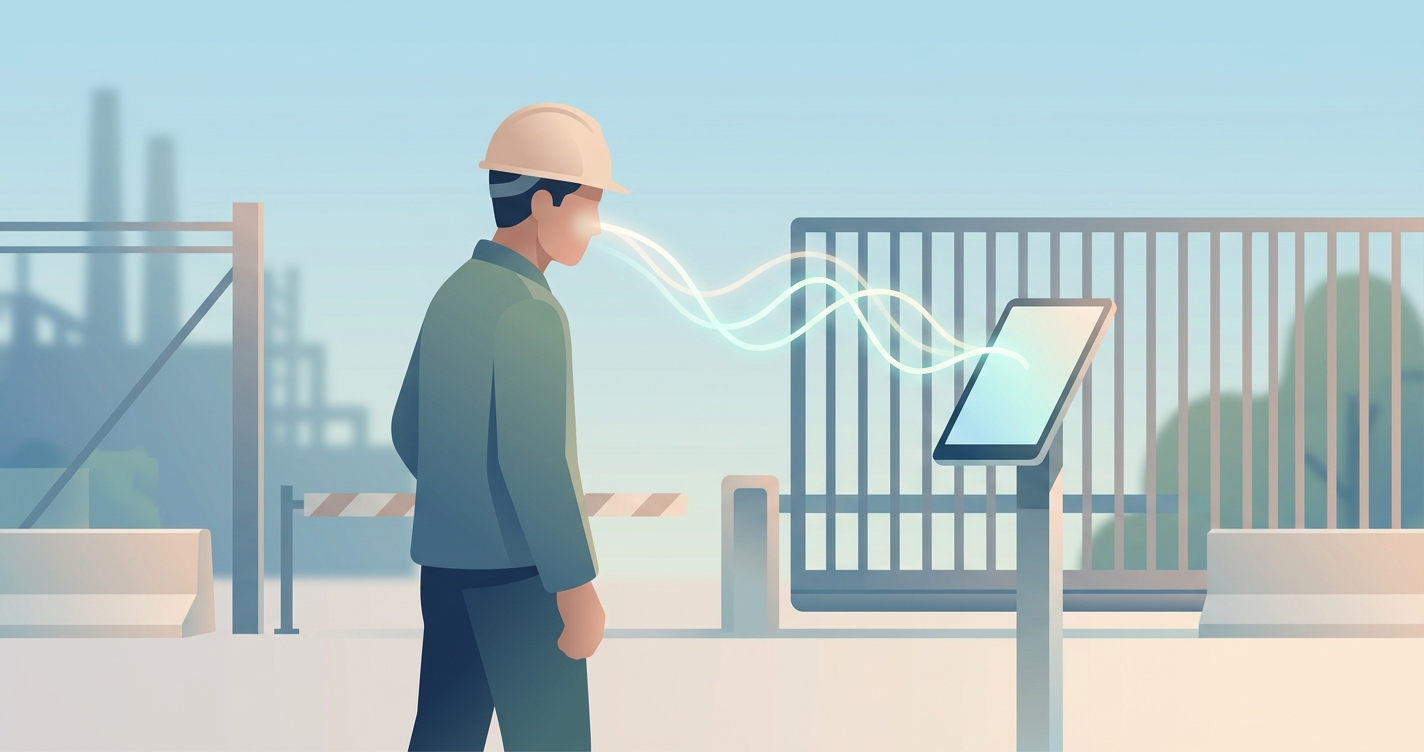
The direction of travel is toward faster, contactless, and continuous measurement. As camera-based photoplethysmography improves, capturing heart rate, HRV, and breathing from a brief facial scan, the pre-shift gate check starts to look like a few seconds in front of a tablet rather than a trip to a clinic. The next frontier is individualized baselining, where a worker's own normal range becomes the reference point, so a screening flags meaningful deviation rather than comparing everyone against a population average.
Expect tighter integration with fatigue risk management systems, where a screening result feeds a broader scorecard that also weighs shift timing, hours worked, and prior sleep. The measurement is only the input. The value for safety teams comes from turning that input into a defensible, consistent decision about who is ready to work. Privacy and worker trust will shape adoption as much as accuracy, which favors methods that are quick, transparent, and free of stored bodily samples.
Frequently asked questions
Can fatigue really be detected without a blood test?
Yes. Fatigue is not a substance in the bloodstream, so blood tests cannot measure it directly. It is a physiological state expressed through the autonomic nervous system, which is why heart rate variability, breathing patterns, and eyelid closure are the markers researchers actually use to detect tiredness.
Which vital sign is the strongest signal for fatigue?
Heart rate variability is the most consistently validated single marker in the research, because it reflects the autonomic shifts that accompany drowsiness. Published studies show it performs best when combined with additional signals such as PERCLOS eyelid tracking or respiratory rate.
Is contactless fatigue screening accurate enough for safety-critical work?
Contactless methods can capture multiple vital signs quickly, and multi-signal models have shown strong results in published studies across driving, nursing, and construction. No method is perfect, so screening is best used as one input within a wider fatigue risk management program rather than a sole gatekeeper.
How long does a non-invasive fatigue check take?
Research is pushing measurement windows down sharply. One 2024 study classified driver fatigue from two minutes of heart-rate data, and camera-based scans aim for even shorter checks suitable for a pre-shift gate, far faster than waiting on any lab result.
Circadify is building toward this contactless, vital-sign approach to pre-shift readiness, helping safety teams screen for fatigue without needles, cups, or lab delays. Occupational health providers who want to evaluate a contactless screening trial can start a safety program inquiry at circadify.com/solutions/fraud-detection.