Digital Health Screening for High-Risk Work Environments
Research overview of digital health screening high risk workplace programs, covering fatigue, heat strain, and pre-shift screening trends in safety-critical industries.
Digital Health Screening for High-Risk Work Environments
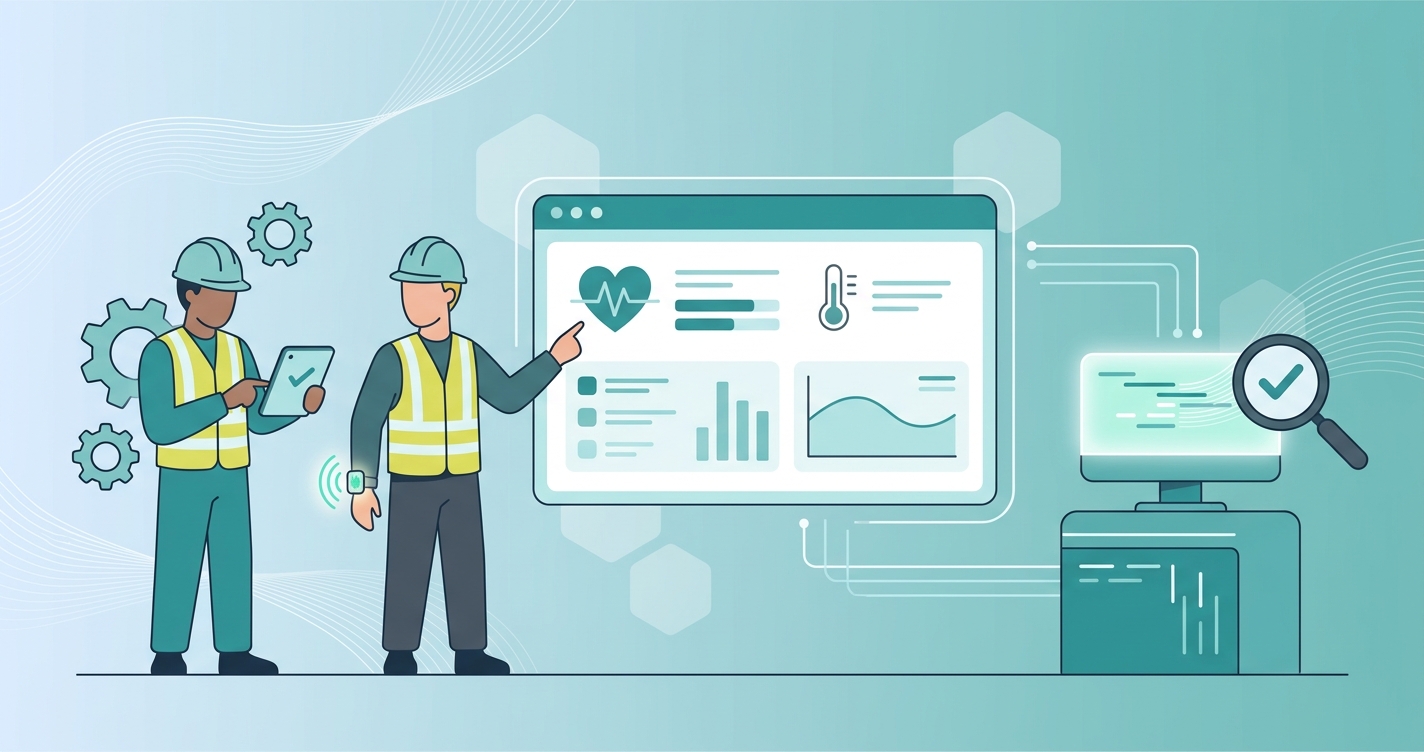
In a high-risk workplace, small physiological changes can become safety events long before anyone sees obvious symptoms. That is why digital health screening high risk workplace programs are getting attention across construction, mining, energy, transportation, and heavy manufacturing. The core idea is straightforward: screen workers for fatigue, heat strain, elevated cardiovascular load, and readiness-to-work signals before a shift starts and, in some settings, during the shift as well.
“Wearable devices are well-accepted for preventing heat stress symptoms in outdoor workers” when they provide real-time alerts and personalized feedback, according to Julian Friedrich, Teresa S. Schick, Filip Mess, and Simon Blaschke in a 2025 BMC Public Health scoping review.
Digital Health Screening in High-Risk Workplaces: What It Actually Measures
Digital health screening is less about replacing supervisors and more about adding a physiological data layer to existing safety programs. In practice, screening programs usually look for three categories of risk:
- Fatigue-related impairment before a shift, especially in long-hour or night-shift operations
- Heat stress and cardiovascular strain in hot, outdoor, or PPE-heavy environments
- Acute readiness signals such as abnormal heart rate patterns, recovery problems, or signs that a worker may need reassignment
Mohammad Moshawrab, Mehdi Adda, Abdenour Bouzouane, Hussein Ibrahim, and Ali Raad wrote in a 2022 Sensors literature review that occupational fatigue monitoring increasingly uses heart rate, heart rate variability, skin temperature, motion data, eye-blink tracking, EEG, and EMG. That matters because high-risk workplaces rarely fail for just one reason. Fatigue, heat, workload, hydration, schedule disruption, and stress often stack on top of each other.
NIOSH's heat criteria remain useful here even though they predate today's screening platforms. The agency's recommended physiological checks include heart-rate recovery and body-temperature thresholds, which is one reason modern screening programs often focus on trends rather than a single binary pass-fail result.
Comparison of Digital Health Screening Approaches
| Screening Method | Primary Signals | Best Use Case | Typical Timing | Operational Advantage | Main Constraint |
|---|---|---|---|---|---|
| Pre-shift kiosk screening | Heart rate, HRV, facial rPPG, symptom check | Shift start readiness | 30–90 seconds | Fast gatekeeping before assignment | Snapshot only |
| Wearable vital-sign monitoring | Heart rate, skin temp, activity, recovery | Heat and fatigue monitoring during work | Continuous | Detects change during the shift | Requires worker adoption |
| Camera-based contactless screening | Facial blood-flow and pulse signals | Entry points, break rooms, controlled indoor zones | Under 1 minute | Low friction, no wearable needed | Lighting and positioning matter |
| Environmental + physiological monitoring | WBGT or ambient heat plus vitals | Outdoor and hot-process settings | Continuous or periodic | Better context for heat decisions | More integration work |
| Schedule-based fatigue scoring | Hours worked, sleep proxy, overtime, shift timing | Fleet, plant, and contractor scheduling | Before and across shifts | Useful at workforce scale | Does not directly measure physiology |
| Multi-signal risk screening | Combined vitals, activity, environment, schedule | Safety-critical operations | Varies | Strongest risk picture | Governance and workflow complexity |
The pattern across industries is pretty consistent. The closer a job gets to heavy equipment, altitude, confined spaces, live traffic, remote operations, or thermal stress, the more value employers see in a quick readiness screen before exposure begins.
Industry Applications for Safety-Critical Workforce Screening
High-risk environments do not use digital screening for the same reasons. The operational question changes by setting.
Construction and Civil Infrastructure
Construction crews face a messy combination of heat exposure, travel fatigue, short-notice schedule changes, and task reassignment. A morning screen can help a superintendent decide whether a worker should operate equipment, work at height, or stay on lower-risk tasks that day.
The 2025 review by Friedrich and colleagues found that outdoor-worker wearables were most useful when paired with clear intervention rules such as hydration prompts, cooling breaks, and supervisor escalation. In other words, the screen matters less than the response protocol.
Mining, Energy, and Remote Field Operations
Remote operations have long rosters, early starts, and limited margin for error. In these settings, pre-shift screening is often framed as fitness-for-duty support, not wellness programming. That distinction matters to EHS directors because the downstream actions are operational: reassignment, rest, secondary review, or delayed site access.
Sites already thinking about pre-shift fitness for duty screening often expand next into fatigue-specific workflows or heat-risk escalation during peak weather windows.
Transportation and Mobile Equipment
In transportation, the problem is not just whether a worker starts the day impaired. It is whether the worker degrades over the next several hours. That is why mobile environments often combine pre-shift screening with schedule-based fatigue models and periodic checks.
The National Safety Council says 77% of workers report at least one workplace fatigue risk factor, and fatigue contributes to serious injuries and fatalities far more often than incident reports capture directly. For fleet and equipment managers, that makes fatigue screening less of a fringe technology question and more of a risk-control question.
Hot Indoor Manufacturing and Process Industries
Steel, glass, food processing, warehousing, and other hot indoor operations are a different challenge. Workers may not be outside, but metabolic load, radiant heat, and PPE can push them into the same risk territory. Here, digital screening is often used to identify which departments, tasks, or hours of the day are generating the most strain.
That connects closely with broader worker fatigue and vital signs safety programs, especially where heat and fatigue overlap.
Current Research and Evidence
The evidence base is still developing, but it is more concrete than many buyers assume.
Moshawrab and colleagues' 2022 Sensors review found that occupational fatigue detection studies repeatedly return to a similar signal set: heart rate, HRV, movement patterns, eye behavior, EEG, and electromyography. The takeaway for workplace buyers is that fatigue is measurable, but no single sensor captures it perfectly in every setting.
Friedrich, Schick, Mess, and Blaschke reported in 2025 that their review of 19 eligible publications found strong worker acceptance for heat-focused wearable interventions when the technology delivered real-time, understandable feedback. That is an important operational point. High-risk screening programs tend to fail when workers see them as black-box surveillance and succeed more often when the output is visible and actionable.
A 2025 study by Kyosuke Kato, Takuto Nishi, Sinyoung Lee, Li Li, Naoko Evans, and Ken Kiyono pushed the discussion further. Writing about wearable biosensors in occupational settings, the authors proposed a collective heat-stress method based on heart-rate response rather than relying only on fixed environmental rules. Their findings suggested especially high heat-stress burden among obese workers and showed that group-level biosensor data can help quantify whether countermeasures are actually working.
That group-level idea is useful for industrial safety managers. It shifts digital health screening from “Did this one worker pass?” to “Which crews, tasks, and conditions are producing strain across the workforce?”
NIOSH and related occupational guidance also continue to support physiological monitoring concepts such as recovery heart rate, sustained elevated heart rate, and body-temperature management. Even where regulation does not prescribe a specific technology stack, the direction is clear: physiological monitoring is becoming easier to operationalize in environments where subjective reporting alone is unreliable.
The Future of Digital Health Screening for High-Risk Work Environments
The next phase will probably be less about gadgets and more about workflow maturity.
A few changes are already visible:
- More contactless screening at controlled entry points for pre-shift checks
- More blended programs combining scheduling data, environmental data, and vital signs
- More team-level analytics to identify hotspots by task, location, or shift pattern
- More privacy scrutiny around biometric handling, retention, and consent
There is also a practical shift underway. Buyers are moving away from asking whether screening can produce a reading and toward asking whether the reading leads to a useful operational decision. Does it trigger hydration? Rest? Supervisor review? Task reassignment? That is the real implementation test.
For EHS directors, occupational health providers, and industrial safety managers, the strongest programs are likely to be the ones that treat digital screening as one layer in a broader safety system. Screening does not replace acclimatization, staffing discipline, incident review, or heat planning. It gives those programs better inputs.
Frequently Asked Questions
What is digital health screening in a high-risk workplace?
It is the use of digital tools to assess worker readiness and physiological risk before or during a shift. Common targets include fatigue, heat strain, abnormal cardiovascular load, and recovery problems in safety-critical jobs.
Which industries benefit most from digital health screening?
Construction, mining, oil and gas, transportation, manufacturing, warehousing, utilities, and other environments with heat exposure, long shifts, heavy equipment, or physically demanding tasks tend to be the best fit.
Is digital health screening the same as wellness tracking?
No. In high-risk workplaces, screening is usually tied to safety and fitness-for-duty decisions rather than general wellness engagement. The focus is on immediate operational risk.
What signals are most commonly used?
Heart rate, heart rate variability, skin temperature, activity, eye behavior, schedule data, and environmental heat measurements are the most common inputs described in current occupational research.
Can digital screening work without wearables?
Sometimes. Contactless camera-based screening and kiosk-based check-ins can support pre-shift workflows, especially in controlled indoor settings. Continuous monitoring in the field usually still benefits from wearable or integrated sensor systems.
Digital health screening is moving from pilot concept to practical safety infrastructure in high-risk workplaces. If your team is exploring how contactless physiological screening could fit into pre-shift safety workflows, Circadify is actively building for this category and broader workforce risk monitoring. Learn more at Circadify's solutions page.