Worker Fatigue and Vital Signs: The Safety Connection Explained
Why worker fatigue changes vital signs, raises safety risk, and is becoming a core metric in occupational health screening programs.
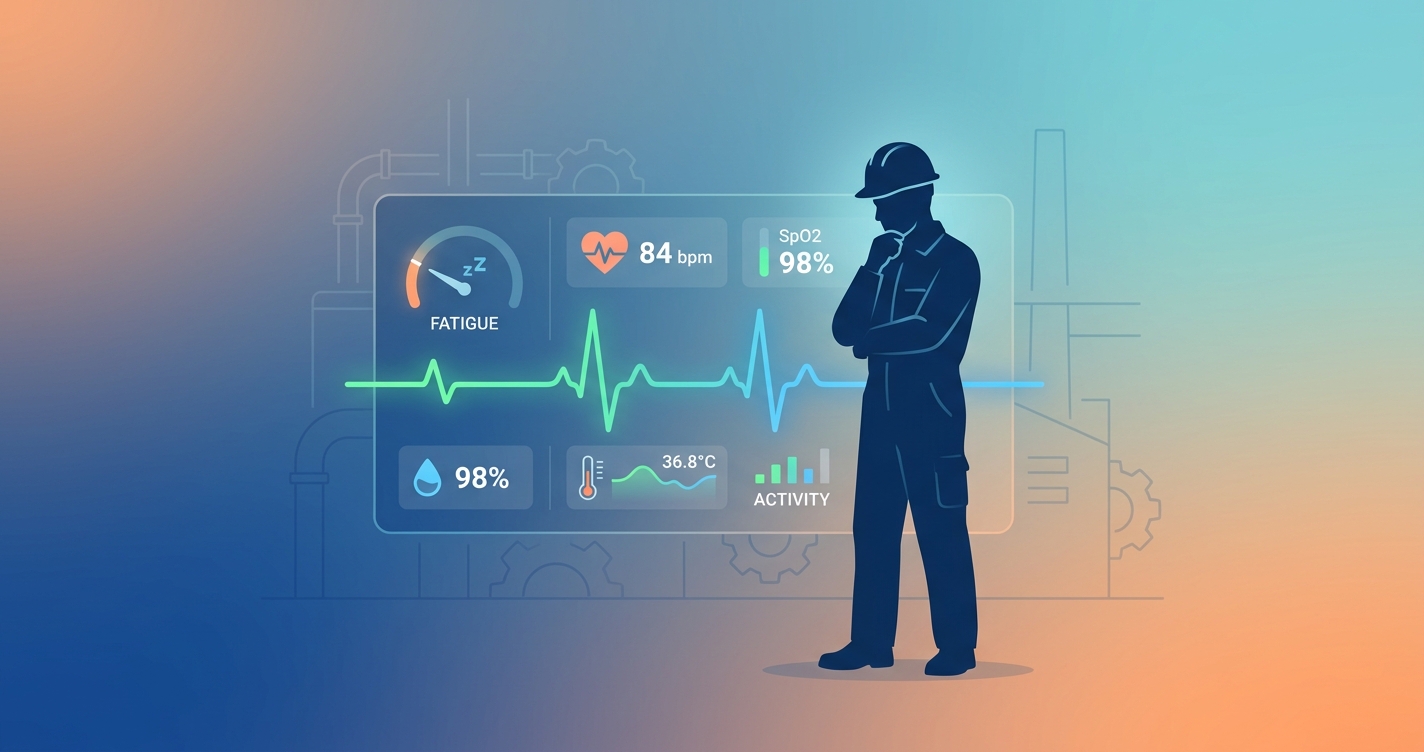
In safety-critical workplaces, fatigue rarely arrives with a dramatic warning. It usually shows up as slower reaction time, poorer judgment, and small physiological shifts that supervisors cannot reliably spot on the floor. That is why worker fatigue vital signs safety has become a more serious topic for EHS teams in 2026. The question is no longer whether fatigue affects safety. It is whether employers can detect the physiological drift early enough to intervene before it becomes an incident.
"Fatigue is a hazard, not a personal failing." — National Safety Council, Fatigue in Safety-Critical Industries (2024)
Worker fatigue vital signs safety: what the body is signaling before an incident
Fatigue changes the autonomic nervous system before it produces an obvious mistake. In practice, that means a tired worker may look normal while their physiological state is already moving in the wrong direction.
Researchers have focused on a handful of measures because they reflect strain, recovery, or circadian disruption in ways that matter operationally:
- Heart rate variability (HRV): lower HRV often signals reduced recovery and higher physiological strain
- Resting heart rate: elevated baseline heart rate can indicate stress, heat load, poor sleep, or incomplete recovery
- Respiratory rate: fatigue and workload can alter breathing patterns, especially when heat or exertion are involved
- Skin or body temperature: temperature changes can point to thermal strain layered on top of fatigue
- Blood pressure trends: sustained stress and poor recovery can push blood pressure upward over time
A 2021 state-of-the-art review by Shahnawaz Anwer and Maxwell Antwi-Afari found that physiological metrics such as heart rate, HRV, skin temperature, and electromyographic signals were among the most useful real-time indicators of physical fatigue in construction workers. A 2024 follow-up review by Haiyi Zong, Wen Yi, Maxwell Fordjour Antwi-Afari, and Yantao Yu reached a similar conclusion: objective fatigue monitoring is becoming more practical as wearable and camera-based sensing improves.
Comparison of vital signs used in worker fatigue monitoring
| Vital sign or metric | What it can indicate | Best use in safety programs | Limits |
|---|---|---|---|
| HRV | Recovery status, autonomic strain, cumulative fatigue | Pre-shift screening, trend monitoring | Best interpreted against personal baseline |
| Resting heart rate | Acute stress, exertion, heat strain, low recovery | Pre-shift checks, secondary review | Less specific than HRV |
| Respiratory rate | Exertion, stress response, heat load | High-risk environments, incident review | Can vary for many reasons |
| Skin/body temperature | Heat stress layered onto fatigue | Outdoor, foundry, energy, remote sites | Strongly affected by environment |
| Blood pressure | Cardiovascular strain, chronic stress burden | Occupational health escalation | Not ideal as a stand-alone fatigue marker |
| Composite readiness score | Combined fatigue signal across multiple inputs | Gate screening and triage | Depends on model quality and workflow design |
The practical takeaway is simple: fatigue does not live in a single number. Most useful programs combine vital signs with schedule context, job demands, and a worker's recent recovery pattern.
Why fatigue becomes a safety problem faster than many programs assume
The safety impact of fatigue is well documented. In the NIOSH review Negative Impacts of Shiftwork and Long Work Hours, the agency summarized evidence showing that accident risk rises on non-day schedules. Research cited there from Simon Folkard, David Lombardi, and Philip Tucker found incident risk increased by roughly 30.4% on night shifts and 18.3% on afternoon shifts relative to morning shifts.
That matters because many of the sectors most interested in contactless or pre-shift screening already operate in the conditions where fatigue compounds quickly:
- long rotations
- early starts or overnight work
- remote camps or transport corridors
- high heat exposure
- monotonous tasks followed by short bursts of high consequence decision-making
By the time a worker is visibly drowsy, the physiological signs have often been present for a while. Agent-search results tied to the occupational fatigue literature repeatedly point to the same pattern: autonomic changes usually appear before the behavioral failure that gets noticed.
How EHS teams are using worker fatigue vital signs safety data
The better programs are not trying to diagnose workers. They are trying to reduce preventable risk at the point where scheduling, human physiology, and safety management meet.
Typical program designs include:
- Pre-shift readiness screening at entry gates, lamp rooms, or dispatch points
- Targeted checks for high-risk crews such as drivers, crane operators, haul-truck operators, and lone technicians
- Heat-and-fatigue monitoring for outdoor or high-temperature environments
- Trend analysis by shift pattern to identify crews or rotations with chronic recovery problems
- Fitness-for-duty escalation workflows that send flagged workers to occupational health review instead of directly into a hazardous task
This is one reason posts like What Is Pre-Shift Fitness-for-Duty Screening? Technology Explained and How Manufacturing Plants Use Pre-Shift Health Checks have become more relevant across industrial safety programs. They describe the workflow layer. Vital signs provide the physiological layer underneath it.
Three industrial settings where vital-sign changes matter most
Transportation and mobile equipment
Drivers and equipment operators often work in environments where a small lapse becomes a major event. In those roles, fatigue affects scanning behavior, reaction time, lane control, and decision speed. Pre-shift cardiovascular screening is attractive because it can catch poor recovery before a worker gets behind the wheel or into the cab.
Heavy industry and fixed-site operations
Steel, chemicals, energy, and manufacturing all combine repetition with moments of severe consequence. A worker running hot, under-recovered, and physiologically strained may still clock in looking fine. The problem appears later at the control panel, in lockout-tagout execution, or during a complex handoff.
Remote and rotational workforces
Remote crews in mining, oil and gas, utilities, and renewable energy face long travel windows, unusual sleep timing, and fewer recovery supports. These are ideal environments for pre-shift trend monitoring because the fatigue burden is shaped as much by roster design as by individual behavior.
Current research and evidence
The evidence base has grown from theory to something much more operational.
A 2024 updated guideline on the use of heart rate and heart rate variability in occupational medicine and occupational health science concluded that HR and HRV can support objective workload assessment, risk evaluation, and preventive worker-health programs. That matters because it pushes HRV out of the sports-recovery niche and into mainstream occupational health practice.
A broader systematic review of HRV in occupational health also found that reduced parasympathetic activity and lower HRV are commonly associated with occupational stress and fatigue. In plain English: the nervous system tends to look less recovered when workers are strained, sleep-restricted, or overloaded.
The construction literature points in the same direction. Anwer and Antwi-Afari's 2021 review highlighted heart rate, HRV, and skin temperature as promising real-time signals for jobsite fatigue measurement. Zong and colleagues in 2024 argued that combining subjective and objective methods gives safety programs a more useful picture than questionnaires alone.
NIOSH and CDC guidance on shift work adds the operating context. The agency notes that shift work and long hours are associated with short sleep, lower performance, higher injury rates, and more chronic illness. That is one reason fatigue management is slowly moving away from "get more sleep" messaging and toward measurable screening, roster redesign, and targeted intervention.
What current evidence supports with reasonable confidence
- Fatigue changes cardiovascular and autonomic signals in measurable ways
- HRV is one of the most useful monitoring signals when interpreted correctly
- Shift timing and long hours measurably increase accident risk
- Heat, workload, and circadian disruption can stack on top of each other
- Objective screening works best as a triage tool, not as a single definitive diagnosis
Where vital signs fit inside a modern fatigue-risk program
Vital-sign monitoring is not a replacement for scheduling policy, supervisor training, or rest design. It is the missing feedback loop.
Without physiological data, many organizations rely on three weak signals: self-report, visible drowsiness, and post-incident review. None is early enough. Self-report is unreliable when workers fear losing a shift. Visible drowsiness appears late. Post-incident review is obviously too late.
Vital signs help fill that gap by giving safety teams a way to identify workers who may need:
- a re-check before starting work
- reassignment away from a critical task
- a heat-rest cycle adjustment
- occupational health review
- a schedule or roster redesign at the crew level
That is especially relevant for sites that want a wearable-free process. Camera-based systems using remote photoplethysmography can estimate pulse-related signals without requiring a sensor to touch the worker. For high-throughput gates and hygiene-sensitive environments, that changes the economics of adoption.
The future of worker fatigue vital signs safety programs
The next phase is less about inventing new metrics and more about operational fit.
I think that is where many programs either work or fall apart. The science is interesting, but the hard part is deciding what a flagged reading actually changes at 5:42 a.m. when 180 people are about to start shift.
Three trends stand out:
- More baseline-driven models: organizations want readings interpreted against the worker's normal range, not just a generic threshold
- More contactless screening: camera-based systems reduce friction at the gate and avoid wearable compliance problems
- More integration with safety systems: fatigue data is increasingly useful when paired with shift, incident, and task-assignment data
The result is a more realistic view of fitness for duty. Not a binary medical judgment. More of a risk screen that helps EHS teams spot the workers and conditions that deserve a closer look.
Frequently Asked Questions
Which vital sign is most useful for detecting worker fatigue?
HRV is usually the most informative single signal because it reflects autonomic recovery and strain. But most programs get better results when HRV is combined with resting heart rate, schedule context, and environmental conditions such as heat.
Can vital signs alone prove a worker is unsafe?
No. Vital signs are best used for screening and escalation, not as a stand-alone verdict. A flagged reading should trigger a secondary review, not an automatic conclusion about impairment.
Why is fatigue harder to catch in safety-critical work?
Because the early signs are often physiological, not obvious. A worker can still appear alert during a toolbox talk while their recovery, autonomic balance, and reaction capacity are already degraded.
Are contactless systems relevant for fatigue screening?
Yes. Contactless camera-based screening is appealing in industrial settings because it reduces bottlenecks, avoids hygiene issues, and makes repeated screening easier to deploy at scale.
Fatigue is becoming easier to measure, which means it is also becoming harder to ignore. For industrial safety leaders, the value of vital-sign monitoring is not that it predicts everything. It is that it offers an earlier signal than observation alone. Solutions like Circadify are being built around that shift, using contactless vital-sign capture to support pre-shift screening and fatigue-aware safety workflows in high-risk operations.