How Transportation Companies Monitor Driver and Operator Fitness
An industry analysis of transportation driver operator fitness monitoring, from fatigue screening and HRV to rail and aviation risk programs.
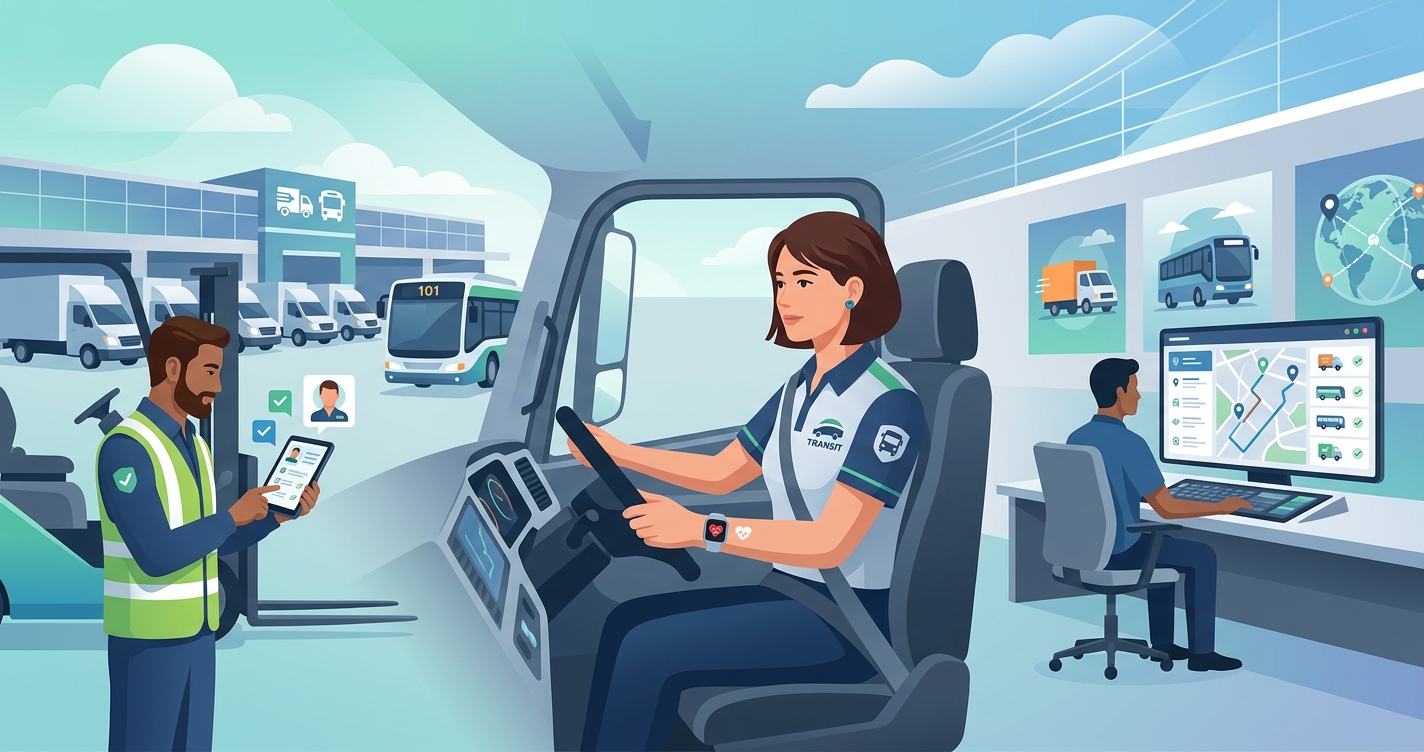
In transportation, the dangerous moment is rarely the obvious one. It is often the routine departure, the familiar route, the late-shift handoff, the operator who looks fine but is physiologically running on too little sleep, too much strain, or both. That is why transportation driver operator fitness monitoring is moving from a compliance conversation into a risk-management one. Trucking fleets, rail operators, transit agencies, and aviation teams are all trying to answer the same basic question: how do you spot reduced readiness before it turns into a safety event?
"Fatigue is a hazard, not a personal failing." — National Safety Council, Fatigue in Safety-Critical Industries (2024)
Transportation driver operator fitness monitoring is shifting from paperwork to physiology
Historically, transportation fitness programs leaned on scheduling rules, supervisor observation, self-reporting, and post-incident review. Those tools still matter, but they all have one weakness: they tend to catch problems late.
What is changing now is the use of objective signals that can be reviewed before a trip, a shift, or a high-consequence task begins. In transportation settings, that usually means some mix of:
- fatigue screening before dispatch
- schedule and hours-of-service review
- sleep disorder screening
- cardiovascular or autonomic measures such as heart rate and HRV
- camera-based observation for visible impairment or drowsiness
- escalation workflows for workers who need a secondary review
The underlying logic is straightforward. If fatigue, heat strain, stress, and poor recovery change the body before they change behavior, then physiological screening gives safety teams an earlier window to intervene.
A 2022 systematic review in Accident Analysis & Prevention by Ke Lu, Anna Sjörs Dahlman, Johan Karlsson, and Stefan Candefjord concluded that heart rate variability remains a promising signal for driver-fatigue detection, even though study methods and model performance still vary. That is an important finding because it reflects where the field really is: useful enough to matter, but still dependent on context, baselines, and workflow design.
Comparison of transportation fitness monitoring approaches
| Monitoring approach | What it measures | Where it fits best | Main advantage | Main limitation |
|---|---|---|---|---|
| Hours-of-service and roster controls | Time worked, rest windows, schedule exposure | Trucking, rail, aviation, transit | Easy to audit and standardize | Does not measure actual physiological readiness |
| Medical certification and sleep-disorder screening | Known health risks, apnea, chronic conditions | Commercial fleets and regulated operators | Strong compliance value | Point-in-time, not shift-by-shift |
| Pre-shift vital-sign screening | Pulse-related signals, readiness indicators, recovery strain | Dispatch yards, depots, terminals, crew rooms | Fast triage before duty | Best used with follow-up review |
| Camera-based fatigue screening | Facial cues, blink rate, visible drowsiness | Cabs, gates, control rooms | Passive and scalable | Often detects later-stage fatigue |
| Wearable monitoring | HR, HRV, sleep and recovery trends | High-risk crews and pilot programs | Better longitudinal insight | Compliance and device burden |
| Composite risk scoring | Combined schedule, physiology, and task context | Mature safety programs | Better operational decisions | Requires policy and integration work |
The big takeaway is that transportation companies are not choosing between compliance and screening. The better programs are layering them.
Why transportation companies care about fitness screening now
The risk case is not theoretical. According to the Federal Motor Carrier Safety Administration, the Large Truck Crash Causation Study found that about 13% of commercial motor vehicle drivers involved in serious crashes were considered fatigued at the time of the crash. That number gets attention because it probably understates the problem. Fatigue is often harder to prove than alcohol or mechanical failure, especially after the fact.
FMCSA has been pointing operators toward broader fatigue-management models for years. Its North American Fatigue Management Program was built around training, sleep-disorder screening, scheduling practices, and fatigue-monitoring technologies rather than hours-of-service rules alone. That tells you something important: regulators and researchers no longer treat fatigue as a simple rule-breaking problem. They treat it as an operational health problem.
That shift is showing up across transportation sectors for a few reasons:
- routes are longer and staffing buffers are thinner
- 24/7 operations push more workers into circadian low points
- incident costs are too high to rely on observation alone
- operators want faster pre-duty screening without wearable bottlenecks
- safety teams need documented escalation paths, not gut judgment
This is also why posts like What Is Pre-Shift Fitness-for-Duty Screening? Technology Explained and Worker Fatigue and Vital Signs: The Safety Connection Explained matter in the transportation context. They frame readiness as something measurable, not just discussable.
Industry applications across trucking, rail, transit, and aviation
Trucking and logistics fleets
In trucking, the practical problem is dispatch risk. A driver may be legally allowed to work and still arrive under-recovered. That gap between legal duty status and actual readiness is where monitoring programs are getting more attention.
Fleet operators typically start with screening for sleep apnea, roster quality, and fatigue education. The next layer is pre-dispatch review: short health checks, alertness checks, or contactless vital-sign screening at the yard. The goal is not to diagnose a driver. It is to flag cases that deserve a second look before a long route begins.
Rail operations
Rail has been unusually explicit about fatigue as a system risk. The Federal Railroad Administration has repeatedly described human factors as the leading cause of reportable non-grade-crossing train accidents, and that is part of why it now requires fatigue risk management programs for certain passenger and freight railroads.
Rail fitness monitoring tends to focus on schedule design, call windows, cumulative fatigue exposure, and high-risk duty periods. But the logic for adding pre-shift physiological screening is strong, especially for dispatchers, engineers, and crews starting irregular shifts at circadian low points.
Public transit and bus operations
Transit agencies deal with a different pressure pattern: split shifts, urban stress, repetitive routes, and thin staffing margins. The issue is less about one spectacular fatigue event and more about a steady accumulation of smaller risks — delayed reaction time, impaired scanning, and decision errors during dense traffic operations.
For transit settings, short screening workflows matter more than elaborate monitoring systems. If the process slows down pull-out time, it usually dies in procurement or labor review.
Aviation and flight operations
Aviation has some of the deepest fatigue science in transportation. Mark Rosekind, David Neri, and colleagues at NASA Ames helped shape the modern fatigue-countermeasure framework by studying circadian disruption, cockpit performance, and alertness strategies in real operations. Aviation programs still rely heavily on scheduling science and fatigue risk management systems, but the broader lesson has carried into surface transport: fatigue must be managed as a measurable operational hazard, not as a personal weakness.
Current research and evidence
The research base is broad enough now to support a few practical conclusions.
First, autonomic and cardiovascular measures are useful because fatigue changes them before a worker necessarily looks impaired. Lu and colleagues' 2022 review found that HRV-based driver-fatigue detection is promising, but also noted inconsistent methods and uneven validation across studies. That is exactly why mature programs avoid using a single threshold as a final answer.
Second, transportation regulators are increasingly treating fatigue as a structured risk-management issue. FMCSA's fatigue-management materials place technology alongside education, scheduling, and sleep-disorder treatment. FRA has gone further by requiring formal fatigue risk management programs for some rail operators. In other words, the policy environment is moving in the same direction as the physiological evidence.
Third, cross-modal fatigue research keeps landing on the same uncomfortable truth: operators can be functionally degraded before anyone notices. That helps explain the appeal of pre-shift screening in depots, terminals, crew rooms, and dispatch centers.
What the evidence supports with reasonable confidence
- fatigue can be measured indirectly through physiological and behavioral signals
- schedule compliance does not guarantee real-world readiness
- HRV and pulse-related measures are useful, especially when compared with a worker's baseline
- rail, trucking, and aviation all benefit from fatigue risk management frameworks
- screening works best as triage, not as a stand-alone medical judgment
Where transportation fitness monitoring is heading
I think the most interesting change is not the sensor itself. It is the workflow around the sensor.
A lot of transportation organizations have learned the hard way that gathering more data does not automatically make a program better. The question that matters is simpler: what changes when a reading looks wrong?
The next generation of transportation driver operator fitness monitoring is likely to look like this:
- more contactless screening at the start of duty so fleets can screen quickly without device distribution
- more baseline-aware interpretation so workers are compared against their normal range instead of a one-size-fits-all cutoff
- more integration with dispatch and safety systems so a flag leads to reassignment, review, or a rest decision
- more focus on cumulative fatigue rather than just catching visibly drowsy operators
That matters for EHS leaders and safety managers because transportation risk often builds quietly. The failure point may happen at mile 180, at a signal, at a platform approach, or on final descent, but the readiness problem usually starts earlier.
Frequently Asked Questions
What does driver and operator fitness monitoring actually measure?
Most programs combine schedule data, medical screening, and fatigue indicators. More advanced systems add pulse-related signals, HRV, or camera-based observation to estimate whether a worker may be under-recovered or impaired.
Is hours-of-service compliance enough to prove a worker is fit for duty?
No. Compliance helps control exposure, but it does not directly measure whether a worker slept well, recovered properly, or is physiologically ready for a safety-critical task.
Why is HRV discussed so often in transportation fatigue monitoring?
Because HRV reflects autonomic nervous system activity and recovery status. Researchers see it as a promising fatigue marker, especially when it is interpreted alongside work history and individual baseline data.
Are contactless systems relevant in transportation settings?
Yes. Contactless screening is attractive at depots, crew rooms, terminals, and dispatch points because it reduces friction, avoids wearable management, and makes repeated checks easier to operationalize.
Transportation companies are under pressure to make fitness-for-duty decisions that are faster, fairer, and less subjective than visual observation alone. That is where contactless vital-sign workflows are starting to fit. Solutions like Circadify are being built for that shift, giving safety teams a way to add physiological screening to pre-duty decision-making without turning the start of a shift into a bottleneck.